Want more strategies like this?
Join our free newsletter to get weekly Band 9 frameworks delivered straight to your inbox.
Most candidates walk into the IELTS Speaking test treating Part 1 like an interrogation. They are tense, over-prepared, and second-guessing every word before it leaves their mouth.
But Part 1 is not designed to be the hard part. It is a warm-up — a gentle easing-in before the more demanding sections that follow. The problem is that misunderstanding its purpose leads to two very common mistakes that damage your score right from the start.
What Actually Happens in Part 1
Part 1 lasts four to five minutes. The examiner asks you about familiar, everyday topics — your work, your studies, your hometown, your hobbies. Nothing obscure or abstract. These are topics you have thought about your entire life.
The first few questions are always predictable: where you are from, whether you work or study, what your home is like. After that, the examiner moves into what I call the Topic Roulette — a rotating set of everyday subjects that can range from food and travel to mirrors, robots, or keys. Yes, keys. That was one of the topics I was asked about in my own real IELTS test.
The variety can feel unsettling, but the good news is that the A.R.E. Framework™ works for all of it — even the strange ones.
The Two Traps That Kill Part 1 Scores
Because the questions feel simple, candidates tend to fall into one of two opposite mistakes.
The first is the one-word answer. The examiner asks “Do you like reading?” and the response is “Yes.” Full stop. This gives the examiner almost no language to assess. Every criterion — Fluency, Vocabulary, Grammar, Pronunciation — needs spoken sentences to evaluate. One word produces nothing.
The second is over-talking. The candidate treats every question as an invitation to tell their full life story. Five minutes on their hometown. Three minutes on their morning routine. Part 1 answers that run too long eat into the examiner’s time, disrupt the natural flow of the section, and can actually signal poor control of response length — which affects your Fluency & Coherence score.
The target is what I call the Goldilocks Zone: answers that are not too short and not too long. In practice, that means roughly two to three sentences — about 20 seconds per answer.
The A.R.E. Framework™
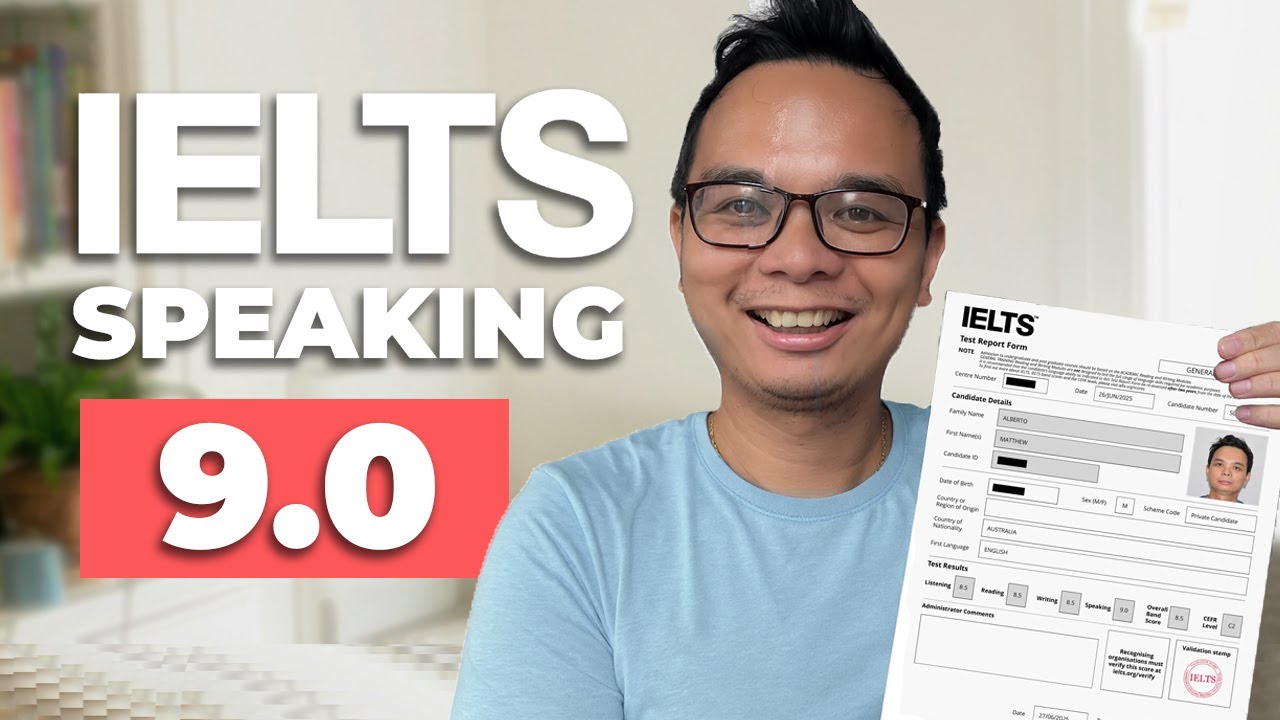
To hit that Goldilocks Zone consistently without overthinking it, I use the A.R.E. Framework™. I created this for my own IELTS preparation, and it is the structure I relied on in the real exam where I scored Band 9.
The three steps are:
- A — Answer: Respond directly to the question. Don’t delay or hedge.
- R — Reason: Explain why. One clear reason is enough.
- E — Example: Make it concrete with a short, specific detail.
That is the entire structure. Three steps, 20 seconds, done.
Seeing It in Action
Question: “Do you like reading?”
A Band 5 response: “Yes, I like reading.”
A Band 9 response using the A.R.E. Framework™:
“Yes, absolutely — I’m a bit of a bookworm. I find it’s the best way to unwind after a stressful day at work. In fact, I’m reading a thriller novel right now that I just can’t put down.”
Same question. Same opinion. Completely different score potential.
Notice what happened structurally: a direct answer (“Yes, absolutely”), a reason (“the best way to unwind”), and a specific example (“a thriller novel right now”). Three sentences. About 20 seconds. Natural and fluent.
Why the A.R.E. Framework™ Boosts Your Score
The framework does something clever beyond just filling time. When you move from Answer to Reason, you naturally reach for connecting words like “because” or “since.” When you move to the Example, you reach for phrases like “for instance” or “like.”
These are the discourse markers that examiners listen for under the Fluency & Coherence criterion. You are not memorising them — the structure produces them naturally. That is what makes the A.R.E. Framework™ effective: it does not feel like a formula when you use it. It just sounds like a fluent, organised speaker.
What the Examiner Is Really Assessing
Part 1 is assessed on the same four criteria as the rest of the Speaking test:
- Fluency & Coherence — Are your answers connected and flowing?
- Lexical Resource — Are you using a range of vocabulary naturally?
- Grammatical Range & Accuracy — Are your sentences varied and accurate?
- Pronunciation — Are you clear and easy to follow?
Part 1 carries real weight. A strong start builds momentum and sets the examiner’s impression of your English level. A weak start — full of one-liners and long pauses — creates a negative baseline that is hard to recover from in the sections that follow.
Preparing for the Topic Roulette
You cannot predict every topic the examiner will raise in Part 1, but you can prepare a reliable system for responding to any of them.
The A.R.E. Framework™ works across all topics because it is not topic-dependent — it is structure-dependent. Whether the examiner asks about your favourite food or whether you have ever collected anything, the same three steps apply.
To build the kind of automatic fluency that holds up under exam pressure, I practised using the SpeakPrac app — which I helped build for exactly this purpose. It gives you randomised Part 1 questions, lets you record your responses, and provides instant feedback on pacing and length. That feedback is what helped me identify my own tendency to ramble — and cut my answers down to the Goldilocks Zone before test day.
Ready to take your speaking to the next level?
Apply today's tips in the SpeakPrac app and get instant AI feedback on all 4 IELTS criteria. Or master the fundamentals with my complete, free video course.