Want more strategies like this?
Join our free newsletter to get weekly Band 9 frameworks delivered straight to your inbox.
Most students treat IELTS Speaking Part 1 like it’s the “easy” section — the warm-up before the real test begins. So they walk in underprepared, wing their answers, and walk out wondering why their score is stuck below Band 7.
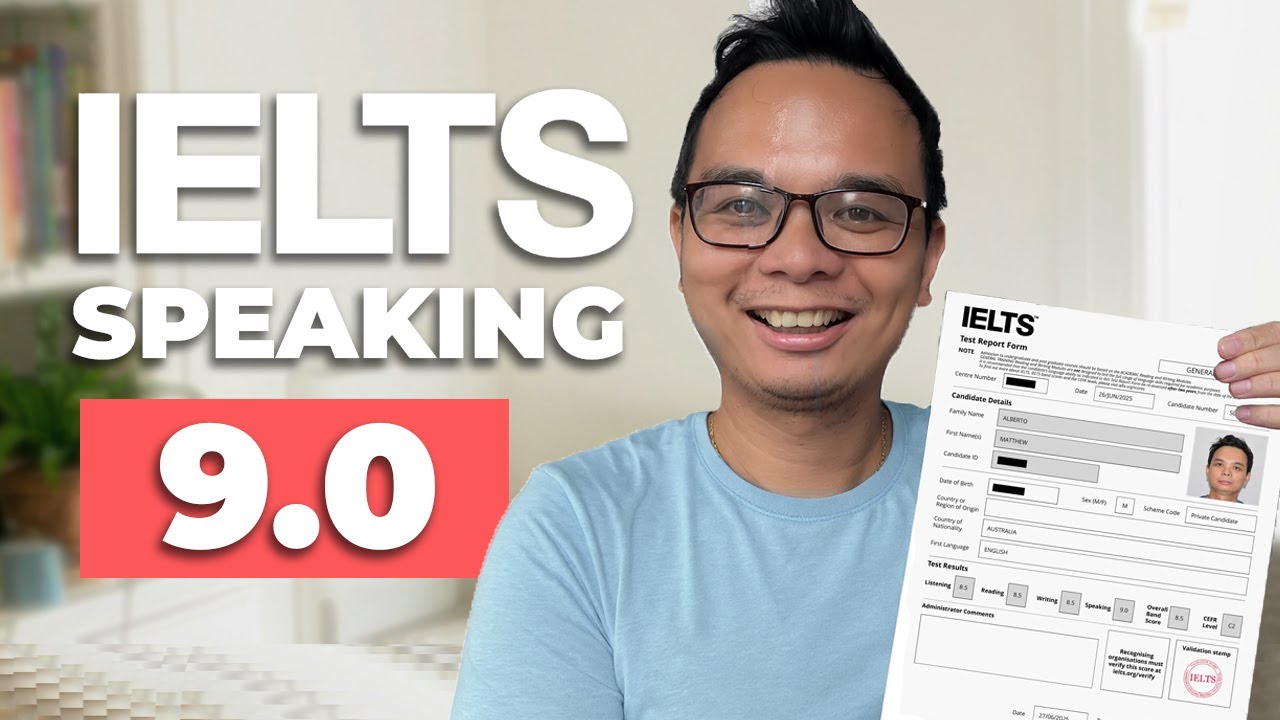
The truth is, Part 1 is not a free pass. It’s a structured scoring opportunity, and the examiner is evaluating your English from the very first word you say. After scoring a Band 9 in IELTS Speaking, I can tell you that Part 1 wasn’t where I relaxed — it was where I locked in my score early. Here’s the exact framework I used.
The Two Mistakes That Are Killing Your Part 1 Score
Before I share the solution, let’s be honest about what’s going wrong for most test-takers.
Mistake 1: Answers That Are Way Too Short
The examiner asks, “Do you enjoy playing video games?” and the student replies: “Yes.”
Then silence.
This gives the examiner almost nothing to assess. There’s no demonstration of Fluency, no opportunity to score your Lexical Resource (Vocabulary), and no complex grammar to evaluate. A one-word answer is essentially a skipped question.
Mistake 2: Rambling Like It’s Part 2
The other extreme is equally damaging. Some students launch into a five-minute story about the first video game they played as a child — and the examiner has to physically cut them off.
Part 1 is not Part 2. You don’t need a long speech. You need something in between: long enough to demonstrate your English skills, short enough to keep the conversation moving.
That sweet spot? Around 20 seconds per answer — roughly two to three sentences.
Introducing the A.R.E. Framework™
The A.R.E. Framework™ is the system I used for every single Part 1 question in my IELTS test. The acronym stands for:
- A — Answer: Give a direct answer to the question.
- R — Reason: Explain why with a brief supporting reason.
- E — Example / Explanation: Back it up with a personal example or a natural expansion.
Three steps. Every time. That’s it.
Seeing It in Action
Let’s take the question: “Do you prefer studying alone or with others?”
Weak response:
“I prefer to study alone.”
One sentence. No development. The examiner has almost nothing to score.
A.R.E. Framework™ response:
“I definitely prefer studying alone because I find that I can focus better without any distractions. For instance, when I was preparing for my university exams, I’d often go to the library early in the morning when it was quiet, and I found that I was able to retain information a whole lot easier.”
Same question. Same idea. But this response:
- Demonstrates better Vocabulary (e.g., retain information)
- Uses natural Grammar with complex sentences (because, when)
- Shows Fluency through the smooth connection of ideas
- Provides an authentic personal example that makes the answer feel real
That’s the difference between a Band 5 and a Band 7+.
Why the A.R.E. Framework™ Actually Works
It Forces You to Develop Your Answer
The biggest problem with unstructured answers is that students get stuck at one sentence. The A.R.E. Framework™ gives you a clear path forward — you always know exactly what comes next.
It Stops You From Rambling
Because you’re only aiming for one sentence per step, you naturally stop once the third step is done. The answer is complete. The examiner can move on. There’s no danger of spiralling into an unrelated five-minute story.
It Mirrors How Native Speakers Actually Talk
Think about a real conversation. If someone asks you a question, you don’t just say yes or no. You give a reason. You share a quick example. That’s natural communication — and the A.R.E. Framework™ gives that natural instinct a structured, scoreable path.
How I Used It on Test Day
When I sat my IELTS Speaking test, I used the A.R.E. Framework™ for every Part 1 question. When the examiner asked about my hometown: answer, reason, example. When she asked about my weekend routine: answer, reason, example.
Because I had a system locked in, I wasn’t spending mental energy trying to organize my thoughts mid-answer. I could focus entirely on the content of what I was saying. That’s where real confidence comes from — not from memorizing scripts, but from having a reliable structure you’ve drilled until it’s automatic.
I built the SpeakPrac app specifically to practice this. I needed a way to tackle random Part 1 topics, record my answers, and get instant feedback — without having to rely on booking a tutor for every single session.
Common A.R.E. Framework™ Mistakes to Avoid
1. Making Your Reason Too Complicated
The R step doesn’t need to be a philosophical argument. A simple, natural reason works perfectly:
- “…because I find it relaxing.”
- “…because I enjoy the challenge.”
Keep it clean and conversational.
2. Forcing an Example When You Don’t Have One
The E step can be either an Example or an Explanation. Don’t force a specific memory if one doesn’t come naturally. A natural expansion works just as well:
“I enjoy reading non-fiction because I’m able to learn about history and science. I also find it far more productive than reading fiction.”
No forced example. Just natural development.
3. Being Too Rigid With the Length
Not every Part 1 question demands the full 20–30 seconds. If the examiner asks “Where are you from?”, a shorter answer is perfectly fine:
“I’m from Sydney, Australia — I’ve lived there most of my life. What I really love is the beach culture and the outdoor lifestyle.”
Use the framework flexibly. The goal is natural, developed communication — not a robotic three-step performance.
The Real Truth About Part 1
Part 1 isn’t about testing your life story. It’s about confirming you can hold a normal English conversation. And with the right structure, anyone can do that confidently.
The A.R.E. Framework™ is that structure. It’s what helped me walk into the exam room calm, organized, and ready — and it’s what helped me score that Band 9.
Ready to take your speaking to the next level?
Apply today's tips in the SpeakPrac app and get instant AI feedback on all 4 IELTS criteria. Or master the fundamentals with my complete, free video course.