Want more strategies like this?
Join our free newsletter to get weekly Band 9 frameworks delivered straight to your inbox.
Every week, thousands of IELTS candidates hand over $20, $30, even $50 an hour to sit across from a tutor and fumble through answers about their hometown. They walk away feeling productive. Their score, however, doesn’t move.
The painful truth? For most students, most of the time, a human tutor is the wrong tool for the job. I know this because I scored a perfect Band 9 in IELTS Speaking—and I didn’t spend thousands of dollars on tutor sessions to get there. I spent that money strategically, at exactly the right moment. This guide will show you how to do the same.
The Economic Reality of IELTS Speaking
To move from a Band 6 to a 7, 8, or 9, you might not need more knowledge. What you almost certainly need is volume—hours and hours of spoken output, repeated daily until your mouth muscles are conditioned, your hesitations disappear, and your brain can access English vocabulary on demand.
If you are paying a tutor to sit and watch you do that foundational drilling, you are burning cash on something you could—and should—be doing alone.
Think of it like the gym. You don’t hire a personal trainer to stand next to the treadmill while you run. You can run on your own. You hire the trainer to fix your form, correct your technique, or spot you on the heavy lifts. Language learning works exactly the same way.
The Two Phases of IELTS Speaking Preparation
There are two distinct phases in effective IELTS Speaking prep. Mixing them up—or paying for professional help during the wrong phase—is one of the most common and costly mistakes I see.
Phase 1: The Drill Phase
The drill phase is about volume. Its goal is to:
- Get your mouth muscles comfortable with spoken English
- Reduce hesitations and filler words
- Train your brain to retrieve vocabulary quickly under pressure
This phase does not require another human being. In fact, having a tutor present during this phase can actively work against you. The social pressure makes you more self-conscious. You fall into what I call exam brain—trying to be perfect rather than being fluent. You stop taking the risks that create real improvement.
When I was preparing for my Band 9, I never hired a tutor for this phase. Instead, I needed a feedback loop that let me drill multiple times per day, on my own schedule, without coordinating a meeting every time. I needed a speaking gym.
So I built one: the SpeakPrac app.
How I Used It to Build Volume
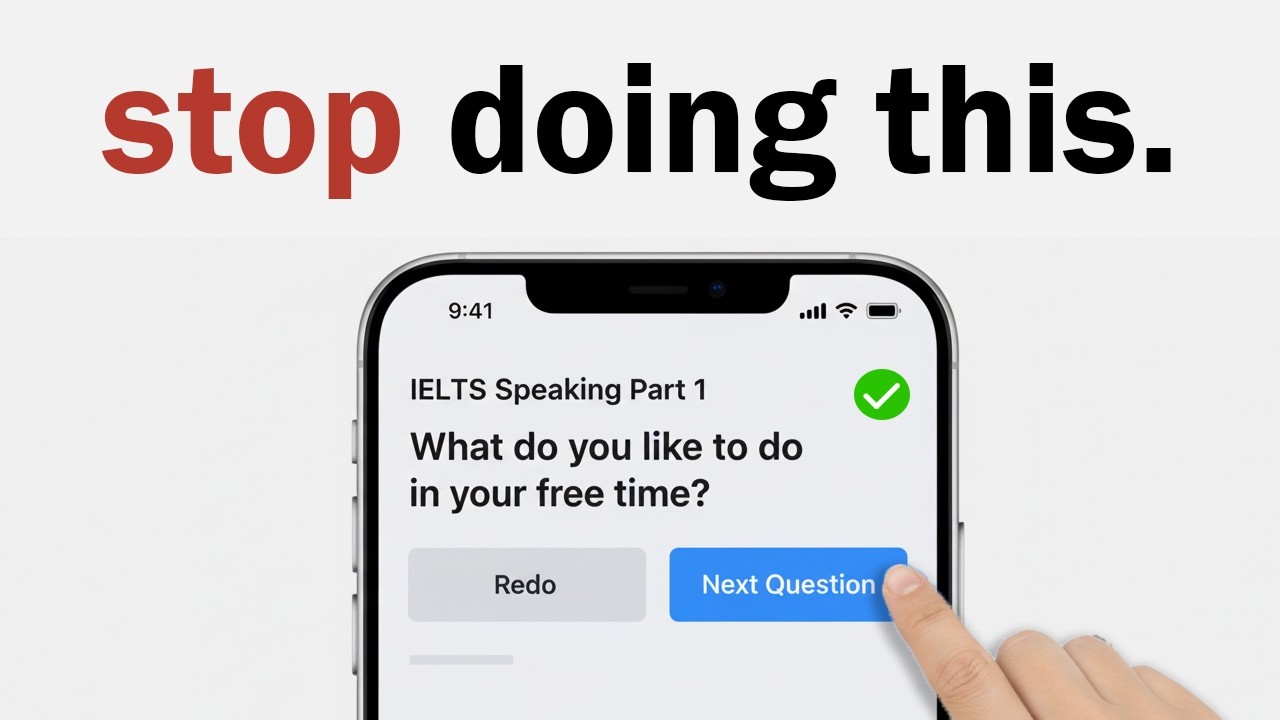
The SpeakPrac app gave me randomized IELTS questions I had to answer instantly—exactly replicating test pressure. After each response, I received:
- A full transcript of what I said
- AI feedback on my answer quality
- Data on my pausing, vocabulary repetition, and answer length
- An estimated band score
This let me practice my core frameworks—the A.R.E. Framework™ for Part 1, the Topic Diamond™ for Part 2, and the I.D.E.A. Framework™ for Part 3—over and over in rapid cycles. I didn’t wait for a tutor’s polite weekly feedback. I drilled, reviewed the data, fixed the problem, and went again immediately.
By the time I sat my official exam, I had recorded hundreds of practice answers. That volume is non-negotiable if you want a Band 9.
Phase 2: The Polish Phase
Once you have done your drilling—once you can speak for two minutes in Part 2 without freezing, and your frameworks feel natural rather than forced—that is the moment to hire a tutor.
Not before. After.
You save your budget for a small number of high-quality sessions close to your exam date. In those sessions, you are paying for something very specific:
- Finding your blind spots. The errors you make so consistently that you can no longer hear them yourself.
- Fixing fossilized grammar mistakes. Bad habits baked in over years that only an experienced teacher can identify and correct.
- Refining your intonation and pronunciation. The final 10% of polish that separates a Band 7 from a Band 8 or 9.
This is the work a great tutor is genuinely valuable for. It is precise, high-leverage, and efficient. Two or three focused sessions in the weeks before your test can have a dramatic impact when you already have the fluency foundation built.
The Most Efficient Preparation Model
Here is the exact approach I recommend, and the one I used myself:
| Phase | Tool | Goal |
|---|---|---|
| Drill Phase | SpeakPrac app (daily) | Build volume, fluency, and framework automaticity |
| Polish Phase | Human tutor (a few sessions) | Fix blind spots, fossilized errors, and intonation |
This approach lets you practice 15 minutes in the morning and 15 minutes at night, without coordinating anyone’s schedule. You open your mouth, you record, you review the data, and you improve. The work is unglamorous. It is also exactly what produces results.
Are Tutors Useless? Absolutely Not.
To be clear: I have worked as an English teacher myself, and I have enormous respect for great language instructors. A skilled tutor at the right moment is one of the best investments you can make.
The key word is right moment. Paying a tutor to sit with you while you do basic drills is like paying a personal trainer to watch you walk. The value is not there yet. Get your hours in first. Build the foundation. Then bring in the expert to refine what you have built.
The Bottom Line
Moving from a Band 6 to a 7, 8, or 9 is not primarily a knowledge problem. It is a volume and feedback problem. Solve that with the right tools, not expensive hourly sessions. Then, when you are genuinely ready to polish—when your frameworks are automatic and your fluency is real—invest in a few targeted tutor sessions to find and fix what you cannot see yourself.
That is the efficient path. That is the path that saves you hundreds of dollars. And based on my own Band 9 result, it is the path that works.
Ready to take your speaking to the next level?
Apply today's tips in the SpeakPrac app and get instant AI feedback on all 4 IELTS criteria. Or master the fundamentals with my complete, free video course.