Want more strategies like this?
Join our free newsletter to get weekly Band 9 frameworks delivered straight to your inbox.
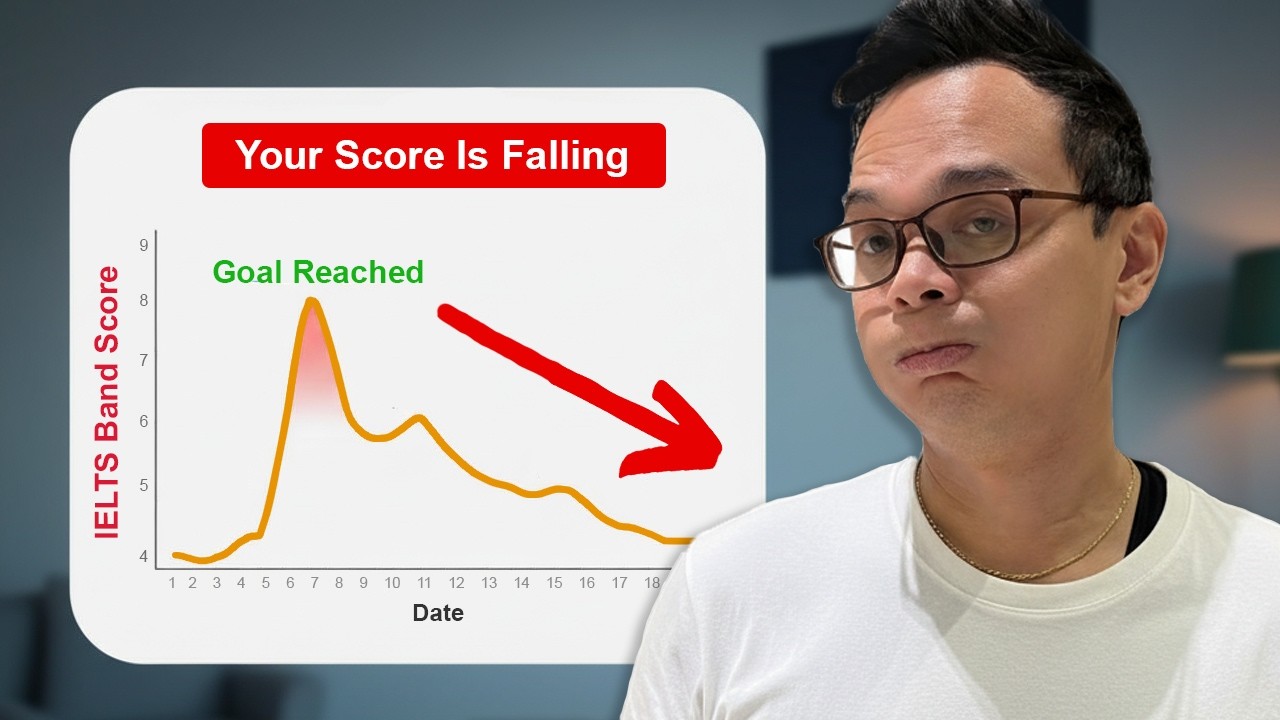
You record answer after answer. You spend hours practicing new topics every single day. Yet when you check your score, nothing has changed. Sound familiar?
This is one of the most common — and most demoralising — experiences for IELTS Speaking candidates. And the cruel irony is that the harder you practice this way, the more stuck you become. A student of mine described it perfectly: “I practice a topic once, then move on to the next one.” That single sentence revealed the exact reason her score hadn’t moved in months.
In this guide, I’ll break down why the one-and-done method is actively sabotaging your progress, what the real difference between testing yourself and training yourself is, and the exact SpeakPrac Cycle™ protocol I used to score a perfect Band 9 — including Band 9 in all four speaking criteria.
The Feedback Misconception: It’s Not What You Think
Many students believe they aren’t improving because they lack the right feedback. My student’s exact complaint was that AI tools “only fix grammar.” She felt she needed a human teacher to truly level up.
She was partly right — and partly wrong.
A human teacher offers something invaluable: motivational support, emotional encouragement, and high-level nuance that AI tools can’t yet fully replicate. But a human teacher has a hard limit: they can’t be available 24 hours a day, giving you instant, detailed feedback on every single answer you record.
Grammar Is Just the Minimum
When I built the SpeakPrac app for my own test preparation, grammar correction was never the primary goal. Grammar is simply a baseline requirement, not a scoring differentiator at the higher bands.
My goal was to learn to speak like a high-level, fluent English speaker. That’s why the improved transcript in the SpeakPrac app goes far beyond fixing grammar mistakes:
- Rewrites your answer to improve coherence and flow
- Upgrades your vocabulary from a lower band level to a higher one
- Provides improved audio so you can model better pronunciation — in Australian, British, or American English, depending on your target accent
The feedback infrastructure is already there. Based on what I’ve seen from students, the real problem isn’t the quality of the feedback. It’s what students do — or don’t do — after they receive it.
The One-and-Done Trap
Here’s the honest truth: if you answer a question once and immediately move on to a new topic, you are not practicing. You are testing yourself.
There is a critical difference between the two.
When you treat your IELTS speaking practice like a checklist — “Question about hobbies: done. Question about travel: done. Next.” — you are only generating a baseline snapshot of your current ability. You haven’t identified your core weaknesses. You haven’t fixed any ingrained habits. Everything stays exactly the same.
Speaking Is Muscle Memory
Think about learning piano. You play a piece, you stumble over a difficult bar, and then you immediately move on to a completely new song. Would you improve? Of course not.
IELTS Speaking works the same way. Speaking is a physical skill driven by muscle memory. And muscle memory is not built through variety — it is built through repetition and focused, deliberate improvement. Each time you abandon a question after one attempt, you leave your mistakes unfixed and your bad habits reinforced.
The Power of Three Protocol: How I Trained for Band 9
I didn’t practise by doing thousands of different questions once each. I did significantly fewer questions — but I practised each one approximately three times, using a structured cycle. This is the SpeakPrac Cycle™, and it is the foundation of deep practice.
Here is the exact four-step process.
Step 1: Record Your Baseline Answer
Don’t over-prepare. Don’t script anything. Just speak naturally, as you would in the real exam. Hesitate if you need to. Make mistakes — that is the entire point of this step.
This is your baseline. You need to know your starting point before you can improve it.
Step 2: Analyse Your Speech
After recording, review your answer in depth. If you’re using the SpeakPrac app, you’ll get instant, detailed feedback. At this stage:
- Ignore the estimated band score — it’s a distraction at this point
- Focus instead on your fluency metrics (words per minute, pauses per 100 words)
- Read through the improved transcript carefully
- Identify vocabulary and grammar upgrades
For example: maybe you said “I like this movie.” The SpeakPrac app might suggest “I found this film particularly fascinating.”
Now choose one or two upgrades only. Do not try to absorb everything at once. Overloading yourself will slow your progress, not speed it up.
Step 3: Record Your Answer Again — Same Question
Do not move to a new topic. Record the same question again, and this time, deliberately use the new vocabulary you identified. Force the word fascinating into your answer.
This is the moment where real learning happens. You are actively rewiring your brain to access better language under pressure — which is precisely what the IELTS examiner is evaluating. This is where your Lexical Resource score begins to climb.
Step 4: Record Your Answer a Third Time
By your third attempt, something remarkable happens. The new vocabulary — fascinating, particularly, whatever you chose — starts to feel natural. You no longer have to consciously search for it. It’s becoming part of your automatic speech.
Now shift your focus to:
- Fluency — is your speech smoother and more connected?
- Speed and rhythm — are you maintaining a natural pace?
- Structure — try applying the A.R.E. Framework™ (Answer, Reason, Example) to make your response more coherent
In the vast majority of cases, this third attempt will sound like it belongs at a significantly higher band level than the first.
Why Repetition Works (When Done Right)
I genuinely believe that anyone can speak English at a high level. It is not a question of natural talent or personality. It is a question of your tolerance for deliberate, repetitive practice.
Most students get bored answering the same question multiple times. The excitement of a brand-new topic feels more productive — but that feeling is misleading.
You Are Competing Against Yourself
This is why the SpeakPrac app tracks metrics like:
- Words per minute — a proxy for fluency and confidence
- Pauses per 100 words — a proxy for hesitation and processing speed
You are not competing against the examiner. You are not competing against other candidates. You are competing against your previous attempt. The goal is simple: beat your own last performance, one attempt at a time.
That incremental improvement, stacked repeatedly over weeks, is what produces a Band 7, Band 8, or Band 9 result.
The Bottom Line: Stop Testing. Start Training.
If your IELTS Speaking score has plateaued, the solution is not more questions. It is better repetitions of fewer questions.
The shift to make:
- Stop: Answering a question once and moving on immediately
- Start: Using the SpeakPrac Cycle™ — baseline, analyse, improve, repeat
- Stop: Letting your mistakes sit there unfixed
- Start: Proving to yourself, in real time, that you can say the same thing at a higher level
The feedback is already available to you. The frameworks are already there. The only thing standing between your current score and a Band 7, 8, or 9 is the willingness to sit with the same question long enough to actually master it.
Remember: repetition alone won’t get you to Band 9 if your answers are disorganised. Once you’ve locked in the SpeakPrac Cycle™, the next step is learning simple structures for Parts 1, 2, and 3 to make your speech more coherent and examiner-ready.
Ready to take your speaking to the next level?
Apply today's tips in the SpeakPrac app and get instant AI feedback on all 4 IELTS criteria. Or master the fundamentals with my complete, free video course.