Want more strategies like this?
Join our free newsletter to get weekly Band 9 frameworks delivered straight to your inbox.
Most IELTS Speaking students spend weeks grinding through question after question — and their score barely moves. They keep practicing, but they are practicing the wrong things in the wrong order.
I know this because I was almost one of them. But instead of grinding randomly, I built a structured 30-day system from scratch. I walked into an official IELTS Speaking test center, sat with the examiner for 14 minutes, and walked out with a perfect Band 9 — including Band 9 across all four criteria: Fluency, Pronunciation, Vocabulary, and Grammar.
Here is that exact system, broken into four phases. Follow it in order and you will never again wonder why your score is not moving.
Phase 1 — Days 1 to 5: Deconstruction
Most students start by memorizing answers. That is the first mistake.
You cannot predict the exact questions you will be asked. In my actual test, the examiner asked whether I often carry a lot of keys. Keys. There is no script that can prepare you for that level of randomness.
So the first five days were not about answers at all. They were about understanding the rules of the game.
Study the Marking Criteria First
I spent this phase studying exactly how IELTS Speaking is scored. The key realization that changed everything for me: this test is not a test of intelligence, knowledge, or interesting opinions. It is purely a test of communication.
That distinction matters enormously. It means:
- Using a big word incorrectly will drop your score, not raise it.
- Speaking too fast or too slow will drop your Fluency score.
- Sounding robotic or overly formal will work against you.
Once I understood this, I set a clear baseline goal: speak in a way that is natural, clear, and structured. Nothing more, nothing less.
Phase 2 — Days 6 to 15: Installing the Frameworks
Once you understand the rules, the next problem is organizing your thoughts instantly under pressure. This phase is about solving that.
I spent 10 days developing and drilling three specific frameworks — one for each part of the test.
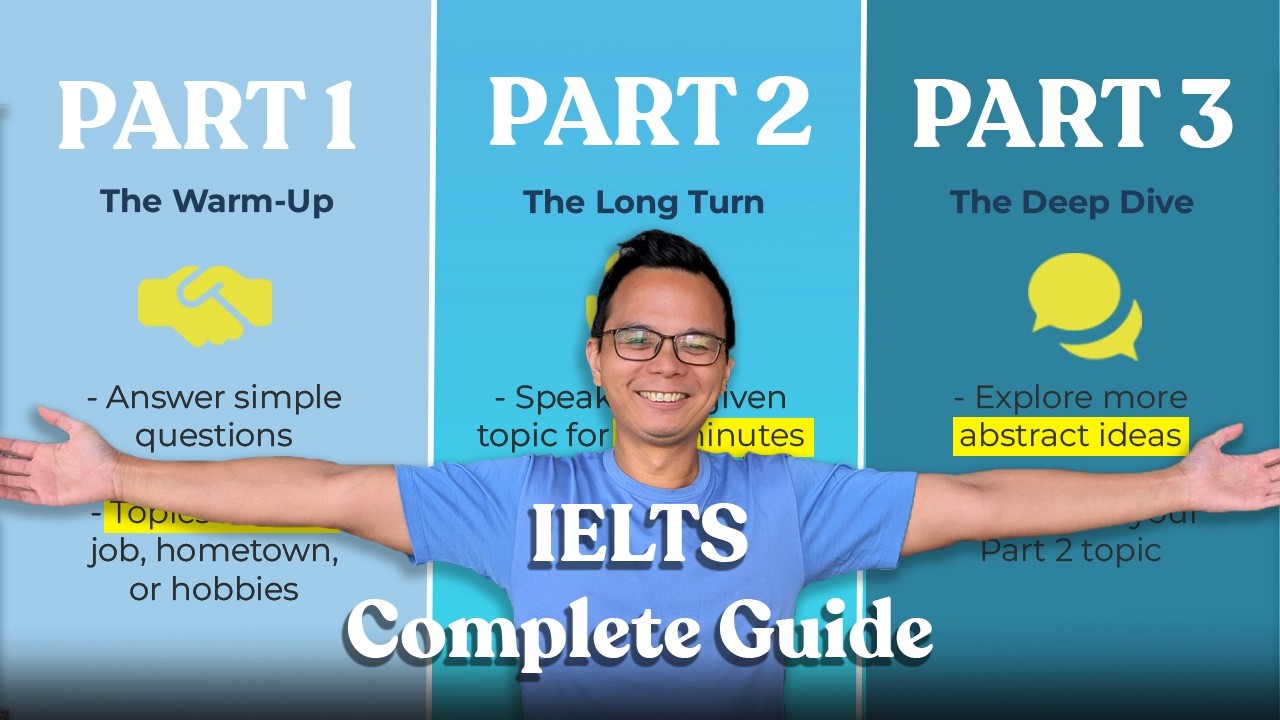
Part 1: The A.R.E. Framework™
For Part 1 short answers, I used the A.R.E. Framework™:
- A — Answer (give a direct answer)
- R — Reason (explain why)
- E — Example or Explanation (make it concrete)
This keeps your responses in the “Goldilocks zone” — not so short that they seem underdeveloped, and not so long that you start rambling. Examiners award higher Fluency scores to candidates who speak at a natural, sustained pace, and the A.R.E. Framework™ makes that automatic.
Part 2: The Topic Diamond™
Most students stare at the bullet points on their cue card and panic. I learned to ignore the bullet points entirely if they were not helping me.
Instead, I used the Topic Diamond™ structure:
- The Past — How did you first encounter this topic?
- The Present — What is your current relationship with it?
- The Future — What do you think will happen next?
- Your Opinion — What do you personally think or feel about it?
This transforms a boring checklist into a story. And stories are far easier to tell fluently for two full minutes. The examiner also rewards this kind of structured narrative because it directly signals high Coherence and Cohesion.
Part 3: The I.D.E.A. Framework™
Part 3 demands extended, abstract responses. Without structure, it is very easy to either fall silent or ramble incoherently.
The I.D.E.A. Framework™ solves both problems:
- I — Idea (state your main point)
- D — Develop (explain it further)
- E — Example (provide a real-world or hypothetical example)
- A — Alternative (acknowledge a contrasting view)
This four-part structure guarantees a high-level extended response every time — which directly boosts your Lexical Resource and Grammatical Range scores because you are naturally forced to use more complex language.
How to Practice in This Phase
For these 10 days, I did nothing but apply these three frameworks to random IELTS Speaking questions. No memorization. No scripts. Just pattern drilling until the structures became automatic.
Phase 3 — Days 16 to 25: The IELTS Speaking Gym
This is where the real work happened.
If you want to learn to swim, you cannot just read about swimming. You have to get in the water. I treated speaking practice exactly like going to the gym: I needed volume and I needed feedback.
The Problem With Typical Practice
I am an introvert. Hiring a tutor every single day felt exhausting, and practicing in front of a mirror felt pointless — a mirror gives you no data.
What I needed was objective, measurable feedback. So I wrote some code and built my own tool: the SpeakPrac app.
How I Used the SpeakPrac App
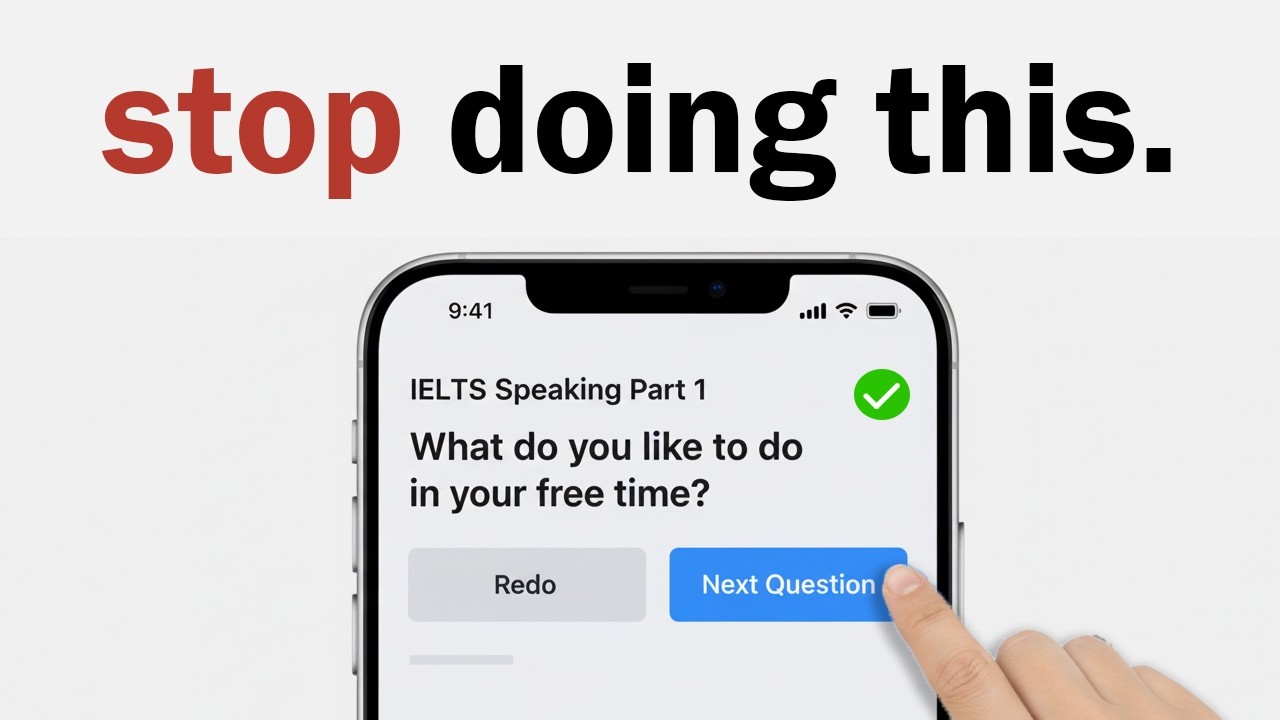
Here is the exact workflow I repeated every day during this phase:
- Record an answer to a random IELTS question
- Review the transcript of my answer
- Analyze the feedback — estimated band score, fluency markers, vocabulary range
- Improve on the next attempt using that data
By the third repetition on the same question type, I consistently noticed higher fluency and naturally more advanced vocabulary and grammar creeping into my answers. That is deliberate practice — not random repetition.
This approach works because it removes the guesswork. Instead of feeling like you are improving, you can see it in the data. And once you can see your progress objectively, staying motivated becomes easy.
Phase 4 — Days 26 to 30: Simulation and Mindset
The final five days were not about learning new content. They were about pressure-testing everything I had built.
Simulate Real Exam Conditions
I stopped pausing mid-speech. I stopped restarting my answers. In a real exam, the clock does not stop — so neither did I.
When I made a mistake, I either quickly self-corrected and moved on, or I simply kept going. Examiners do not penalize you for a single slip; they penalize you for breaking down over it.
Prepare for the Weird Questions
I also used this phase to prepare for genuinely unusual questions. The examiner asking about keys is a perfect example — random, personal, and impossible to script. My preparation was not to prepare answers but to practice staying calm and applying my frameworks to any topic, no matter how unexpected.
Master the Rounding-Off Questions
Many students relax immediately after finishing their Part 2 speech. That is a costly mistake.
The examiner will ask one or two short rounding-off questions directly after your two-minute speech — questions like “Do you think this will change in the future?” These are worth marks, and a fumbled answer right at the end leaves a bad final impression.
I made sure to stay fully switched on until the examiner formally moved to Part 3.
Remove the Exam Brain
The final mindset challenge I worked on was what I call exam brain — the psychological trap where test pressure makes you sound stiff, robotic, or overly formal.
Every day in this phase I reminded myself: speak naturally, sound like a human being, not a textbook. The examiner is not looking for a perfect robot. They are assessing real communicative competence. The more natural and conversational you sound, the higher your Fluency score will be.
The Full 30-Day System at a Glance
| Phase | Days | Focus |
|---|---|---|
| Deconstruction | 1–5 | Understand the marking criteria and set a baseline |
| Framework Installation | 6–15 | Drill the A.R.E. Framework™, Topic Diamond™, and I.D.E.A. Framework™ |
| The Speaking Gym | 16–25 | High-volume deliberate practice with objective feedback |
| Simulation & Mindset | 26–30 | Full exam simulation, rounding-off questions, removing exam brain |
The Key Insight Behind This System
A lot of IELTS Speaking guides tell you to practice more. This plan tells you something different: practice smarter, in the right order, with the right feedback.
Frameworks give your brain a scaffold so you never run out of things to say. Deliberate practice with data closes the gap between where you are and where you want to be. And exam simulation removes the final barrier — test-day psychology — so your true ability shines through.
I genuinely believe that anyone can reach a Band 7, 8, or 9 in IELTS Speaking. You do not need to be a natural extrovert. You do not need to have lived in an English-speaking country. You just need a clear system — and now you have one.
Ready to take your speaking to the next level?
Apply today's tips in the SpeakPrac app and get instant AI feedback on all 4 IELTS criteria. Or master the fundamentals with my complete, free video course.