Want more strategies like this?
Join our free newsletter to get weekly Band 9 frameworks delivered straight to your inbox.
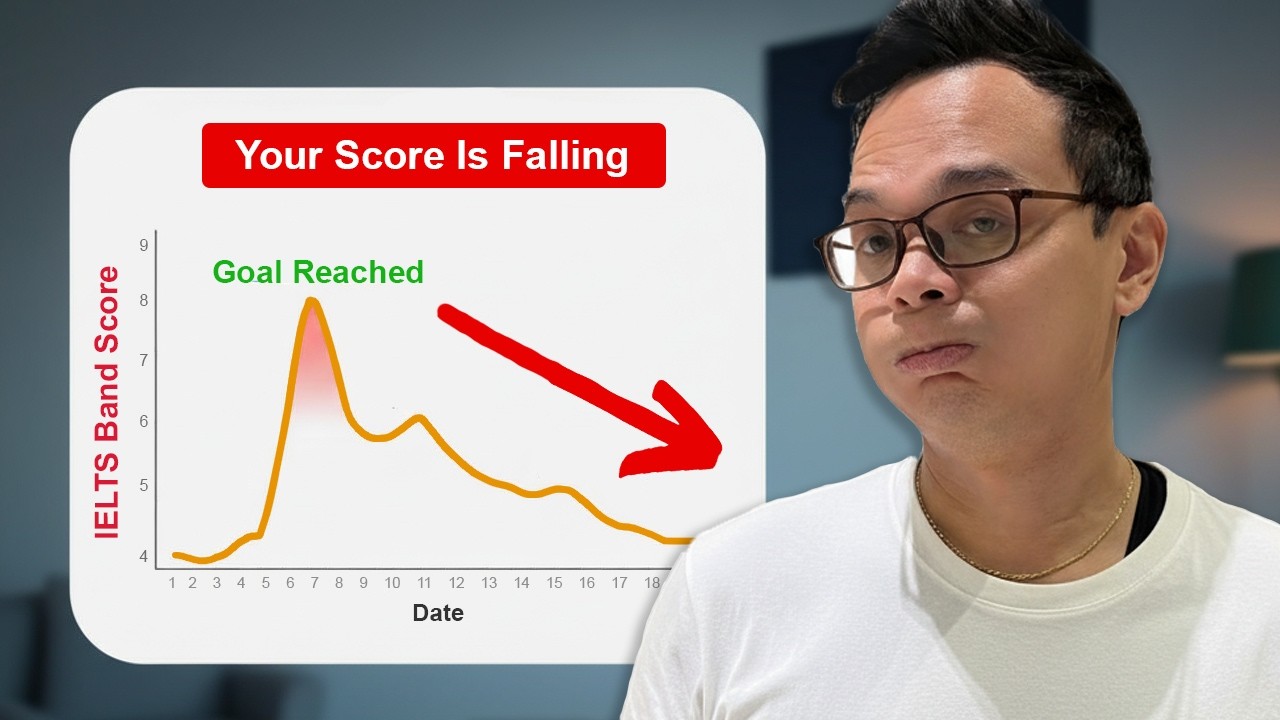
Most IELTS students spend months practicing — and still plateau at Band 6.5 or 7. They memorise vocabulary lists, drill grammar rules, and repeat hundreds of questions. Yet their score refuses to budge.
Here is what nobody tells you: the problem is not how much you are practicing. It is what you believe a Band 9 actually looks like.
I know this because I have been there. I am not a native English speaker. My family spoke Tagalog at home when I was growing up in Australia. I was a shy, introverted kid who had to actively work on my English. And I still walked into my IELTS exam and scored a perfect Band 9 — with Band 9 in every single marking criterion. In this guide, I am going to walk you through the exact strategy I used, so you can do the same.
The Truth About Band 9 (That Most People Get Wrong)
Before we get into tactics, let’s destroy one dangerous myth: Band 9 is not about being perfect.
In my test, I stumbled over words. I made natural pauses. I still got a Band 9. Why? Because IELTS Speaking examiners are not looking for a grammar robot. They are looking for someone who can communicate effectively, naturally, and with range.
The biggest mistake I see is what I call “exam brain” — students who try so hard to sound like a textbook that they stop sounding like a human being. They stuff their answers with impressive vocabulary they barely understand. They speak in an unnaturally formal way. They are so terrified of making an error that they freeze up entirely.
The secret to Band 9 is not perfection. It is being natural, confident, and clear.
Show the examiner the full range of your English — and sound like you are having a real conversation.
The Four Pillars: What Examiners Actually Score
Your IELTS Speaking score is made up of four equally-weighted marking criteria. Each is worth 25% of your final score. To reach Band 9, you need to understand all four.
Pillar 1: Fluency & Coherence
This is about flow and logic. Can you speak smoothly without unnatural pauses? Do your ideas connect in a logical way?
My solution was to use simple answer frameworks so I never had to think about structure mid-answer — only content. Here are the three frameworks I used:
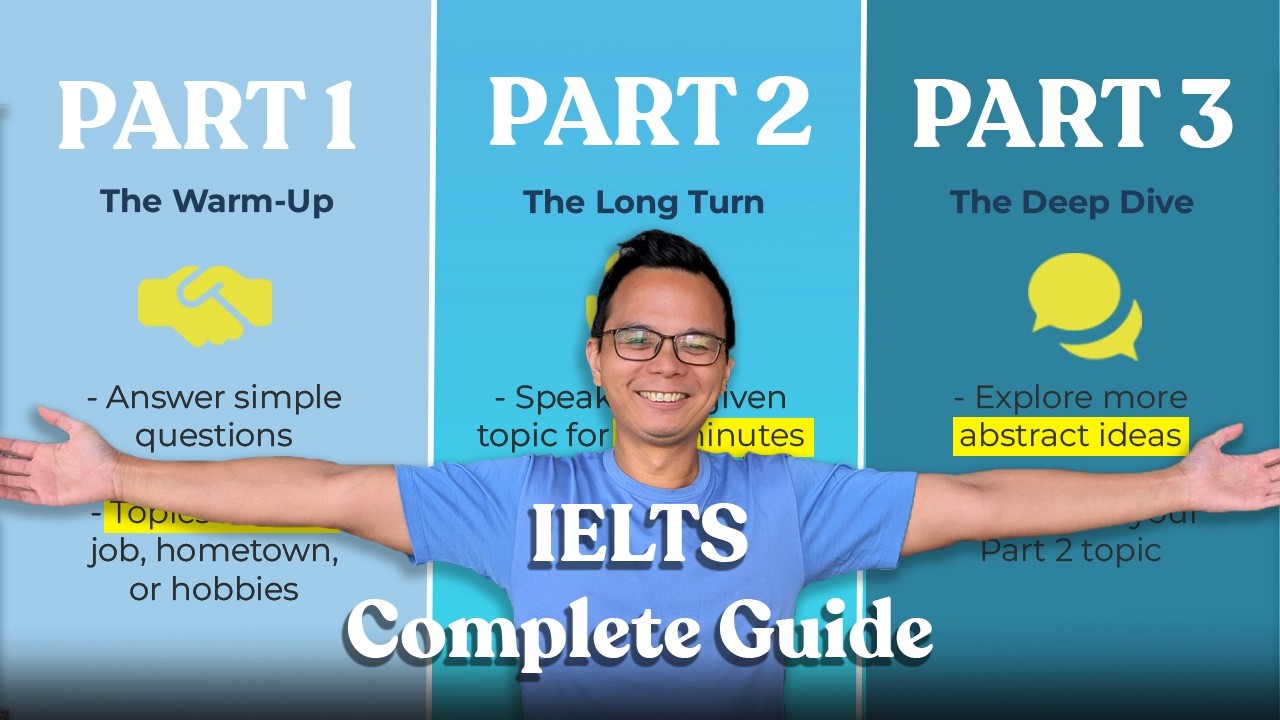
- A.R.E. Framework™ (Part 1): Answer the question → Give a Reason → Provide an Example or Explanation.
- Topic Diamond™ (Part 2): Talk about the Past → the Present → the Future → your Opinion. This gives you a natural two-minute arc for your cue card talk.
- I.D.E.A. Framework™ (Part 3): State your Idea → Develop it → Give an Example → Offer an Alternative viewpoint.
These frameworks act as a mental roadmap. You will never run out of things to say because you already know what comes next.
Pillar 2: Pronunciation
A quick clarification: this criterion is not about having a British, American, or Australian accent. It is about being clearly understood.
There are four components: individual sounds, word stress, sentence stress, and intonation. Of all of them, intonation is the most important for Band 9. Your voice needs to rise and fall naturally. A flat, monotone delivery sounds robotic and disengaged — and it will cost you marks.
The technique I used to improve this was shadowing. I would listen to native English speakers and high-band recordings, pause the audio, and try to copy their melody and rhythm exactly. This trains both your ear and your mouth simultaneously.
Pillar 3: Lexical Resource (Vocabulary)
Here is where many students make a critical error. They think Band 9 requires stuffing every answer with long, complicated words. It does not.
What examiners want is precision, variety, and natural usage. Here is what actually helped me score highly in this area:
- Collocations: These are words that naturally go together. You make a decision, not do a decision. It’s heavy traffic, not big traffic. Using collocations correctly is a strong signal of a high-level speaker.
- Paraphrasing: If you cannot think of a specific word, describe it another way. If you do not know the word accountant, say “someone who manages finances for a company.” This flexibility is what separates a Band 7 from a Band 9.
Pillar 4: Grammatical Range & Accuracy
Band 9 grammar is not about never making a mistake. It is about using a range of grammar structures naturally, while making as few errors as possible.
One technique that genuinely helped me is what I call the mirroring technique: when the examiner asks you a question, listen for the grammar structure they use and mirror it back in your response.
If they ask, “How long have you been learning English?” — your answer should also use the present perfect: “I’ve been learning English for about ten years now.”
Also remember: a complex sentence is not the same as a complicated sentence. A complex sentence connects two ideas with a linking word — because, which, when, although. That is simple but highly effective. A complicated sentence tries to cram too many ideas together, loses coherence, and ends up hurting your score instead of helping it.
My Practice Strategy: What I Did in the Weeks Before My Test
Understanding the theory is one thing. Here is exactly how I put it into practice.
1. I Recorded Myself Constantly
The key is to listen back to yourself. When you do, you will clearly hear the hesitations, the awkward phrasing, and the errors that you miss in real time. Awareness of your speaking mistakes is the first step to fixing them.
I was actually developing the SpeakPrac app during this period because I wanted an instant feedback tool — one that could assess my fluency, give me transcripts, and identify my weak areas without me needing to wait for a tutor. Even a basic voice recorder on your phone can work. The habit of listening back is what matters.
2. I Practiced the Frameworks on Random Questions
Rather than memorising scripted answers, I practised applying the frameworks to random questions. I took a random Part 1 question and used the A.R.E. Framework™. I pulled a random Part 2 topic and used the Topic Diamond™. I found a random Part 3 question and worked through the I.D.E.A. Framework™.
This meant that by the time I sat the actual exam, I did not have to think about how to structure my answer. I just spoke.
3. I Targeted My Weakest Area Ruthlessly
To be completely honest with you: I speak slowly. I go into too much detail. My wife tells me this all the time.
When I checked the SpeakPrac app, my words-per-minute were consistently low. I was taking too long to get to the point. So I used the freestyle speaking mode to practice the same topic repeatedly, each time trying to increase the pace of my delivery. Research actually shows that repeating a topic multiple times can directly improve your fluency on that topic. It worked for me.
4. I Practiced Without a Partner
I did not want to rely on paying for a tutor or scheduling sessions with a native speaker. Instead, I practiced by speaking about daily activities out loud on my own. I looked up real IELTS Speaking questions from past papers and official sources, then answered them — aiming for two minutes per Part 2 topic.
Your mouth is a muscle. You have to train it.
Putting It All Together
Getting a Band 9 in IELTS Speaking was not magic. It was not luck. It came down to three things:
- Understanding exactly what examiners are looking for across all four criteria.
- Using proven frameworks (A.R.E. Framework™, Topic Diamond™, I.D.E.A. Framework™) to stay organised without sounding scripted.
- Practicing with purpose — recording myself, targeting my weaknesses, and speaking every single day.
I was not born in a native English-speaking country. I spoke another language at home growing up. I am naturally introverted and prone to speaking too slowly. None of that stopped me.
A Band 9 is not reserved for English-speaking geniuses. It is available to anyone who understands the system and trains for it correctly. I am proof of that — and I believe you can be too.
Now stop reading and go practice. You have got this.
Ready to take your speaking to the next level?
Apply today's tips in the SpeakPrac app and get instant AI feedback on all 4 IELTS criteria. Or master the fundamentals with my complete, free video course.