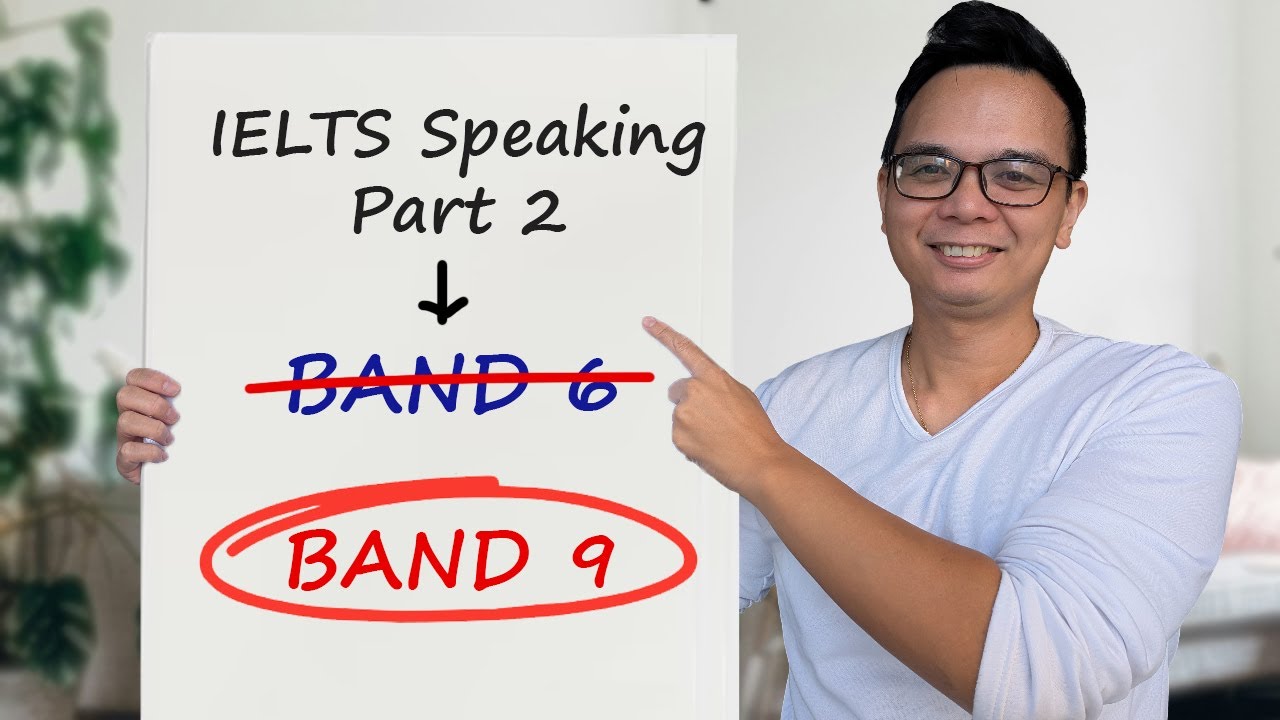
Want more strategies like this?
Join our free newsletter to get weekly Band 9 frameworks delivered straight to your inbox.
The examiner hands you a card. You have one minute to prepare. Then you need to speak — alone, uninterrupted — for two full minutes.
For most candidates, that two-minute target feels impossible. They finish everything they want to say in under a minute, look up at the examiner, and wait. The silence that follows is one of the most damaging things that can happen to your Fluency & Coherence score.
The good news: this problem has nothing to do with your level of English. It has everything to do with structure.
What Actually Happens in Part 2
After Part 1, the examiner hands you a cue card. It contains a topic and a few bullet points suggesting what to cover. You get one minute of preparation time — you can make notes — and then you speak for up to two minutes. After that, the examiner asks one or two brief follow-up questions before moving into Part 3.
The cue card might say something like: “Describe a skill you have learned. You should say: what the skill is, when and why you learned it, how you learned it, and why this skill is important to you.”
Simple enough on the surface. But this is where most candidates go wrong.
The Mistake Almost Everyone Makes
Most students treat the bullet points like a checklist. They give one sentence per bullet point — and then they stop.
Sixty seconds in, they have nothing left to say. They look up at the examiner hoping it is over. The examiner waits in silence. The candidate panics.
That silence is expensive. It directly damages your Fluency score, which the examiner is actively assessing throughout your entire response.
Here is the mindset shift that changes everything: the bullet points are suggestions, not requirements. The only real rule for Part 2 is that you speak about the main topic for up to two minutes. You can expand on the bullet points, reorder them, or ignore them entirely — as long as you keep talking about the central topic.
And here is the deeper reframe: the examiner does not care about your life story. They are not impressed or unimpressed by whether you learned to cook or climbed a mountain. They are assessing how you speak English. Any topic, spoken with structure and fluency, will score well.
The Topic Diamond™
To solve the two-minute problem, I developed the Topic Diamond™ — the framework I used throughout my preparation and in the real exam where I scored Band 9.
It gives you four angles to explore for any cue card topic:
- The Past — How did you first encounter this? What was the background or history?
- The Present — How does it exist in your life today? How do you interact with it now?
- The Future — What are your plans or goals related to this topic?
- Your Opinion — How important is it to you? How does it make you feel?
Each point gives you roughly 20 to 30 seconds of material. Together, they fill two minutes naturally — without forcing you to invent interesting experiences or impressive achievements.
Seeing It in Action
Let’s use the cue card from earlier: “Describe a skill you have learned.”
During your one-minute prep, you might jot down anchor points like this:
- Past: couldn’t cook, moved out, called mum constantly
- Present: cook most nights, complex dishes, no recipe needed
- Future: knife skills, baking classes
- Opinion: creative outlet, relaxing, saves money
Then when you speak, you expand each point naturally:
“One skill I learned was how to cook. When I first moved out, I barely knew how to boil water. I would call my mum constantly — asking how long to cook pasta, whether I needed oil in the pan. It was honestly pretty embarrassing.
Now I cook dinner most nights. I can make complex dishes like curry or pasta from scratch, without following a recipe step by step. I just know what works.
Going forward, I want to learn proper knife skills because I am still quite slow at chopping. I also want to take some baking classes so I can make desserts for my family and friends.
Cooking has completely changed the way I think about food. It has become a creative outlet where I can experiment, and it is so relaxing after work. And honestly, I have saved a lot of money by not eating out every night.”
That is your two minutes. Notice that the response does not follow the bullet points exactly — and that is completely fine. The Topic Diamond™ gave it structure, flow, and enough material to fill the time without running dry.
What the Examiner Is Really Assessing
Part 2 is not a storytelling competition. The examiner is not ranking candidates by how fascinating their chosen skill is.
They are listening for the same four criteria that apply across the entire Speaking test:
- Fluency & Coherence — Can you speak continuously without long pauses? Do your ideas connect?
- Lexical Resource — Are you using a range of vocabulary naturally?
- Grammatical Range & Accuracy — Are you using different tenses and sentence structures correctly?
- Pronunciation — Are you clear and easy to understand?
The Topic Diamond™ addresses Fluency & Coherence directly by giving you a logical structure to follow. When you know what comes next — Past, then Present, then Future, then Opinion — you never have to pause and think “what do I say now?”
Practising Before Test Day
When I sat my IELTS Speaking test, I had no idea which cue card topic I would receive. But I had practised the Topic Diamond™ enough times that I could apply it to anything.
The way I built that confidence was by using the SpeakPrac app — which I helped build specifically for this kind of practice. It gives you random Part 2 cue cards, lets you record your full two-minute response, and delivers instant feedback so you can identify exactly where your answer loses momentum.
The framework is the foundation. Consistent practice under realistic conditions is what makes it automatic.
Ready to take your speaking to the next level?
Apply today's tips in the SpeakPrac app and get instant AI feedback on all 4 IELTS criteria. Or master the fundamentals with my complete, free video course.