Want more strategies like this?
Join our free newsletter to get weekly Band 9 frameworks delivered straight to your inbox.
You’ve spent hours studying grammar tables. You’ve memorised tense names and drilled conditionals. Yet the moment you open your mouth in the IELTS Speaking test, everything freezes. You’re so busy checking whether your sentence is grammatically perfect that you forget to actually say something.
This is what I call the Grammar Trap — and it’s the single biggest reason intelligent, hard-working students score lower than they deserve. I know this because I’ve been there. I sat the official IELTS Speaking test myself and walked away with a Band 9 in Grammatical Range and Accuracy. What I learned completely changed the way I think about grammar — and in this guide, I’m going to share that with you.
The Grammar Trap: Why Thinking Too Hard About Grammar Kills Your Score
Imagine you’re learning to drive a car. The Grammar Trap is like spending the entire lesson staring at the gear stick, panicking about whether you’re in first or second gear. What happens? You forget to look at the road. You can’t steer. You crash.
In the IELTS Speaking test, this “crash” shows up as a low score in Fluency, Pronunciation, and even Vocabulary — because your brain is so paralysed by grammar rules that you can’t communicate naturally. The examiner isn’t looking for a robot. They’re trained to assess how well you communicate. So let’s break down the three myths that lead students straight into this trap.
Myth-Busting: What the Examiner Actually Wants
The official IELTS Speaking band descriptors mention three things for grammar:
- Using a range of structures
- Using complex sentences
- Producing error-free sentences
These three phrases are widely misunderstood. Here’s the truth behind each one.
Myth 1: “A Range of Structures” Means Using Every Tense You Know
Students hear the word range and immediately build a mental checklist: “I’ve used the past perfect — now I need to force in a conditional, then maybe a future perfect continuous…”
This is completely unnatural. Think of grammar like a painter’s palette. A great artist doesn’t splash every single colour onto their canvas at once — that would be a mess. They choose the right colours to paint the picture they want to create.
In your IELTS Speaking test, the examiner’s question is the picture you need to paint. If they ask about your childhood, you’ll naturally use past tenses. If they ask about your future plans, you’ll naturally use future forms. Don’t force it. Just respond.
Myth 2: “Complex Sentences” Means Long, Complicated Sentences
This is the most damaging myth of all. In everyday conversation, “complex” can mean difficult. But in grammar, a complex sentence is a technical term with a beautifully simple meaning — and it does not mean complicated.
Think of sentences like toy blocks:
- A simple sentence is one block with one idea: I like coffee.
- A complicated sentence is when you cram too many ideas into one place: My preference, which has developed over many years, is for coffee, a beverage that, when consumed in the morning, has the effect of assisting me in achieving a state of wakefulness. Sounds fancy — but it’s a mess.
- A complex sentence simply connects two or more ideas neatly using words like because, which, while, when, if, although.
Take these three simple ideas:
I like coffee. I drink it in the morning. It helps me wake up for work.
Connect them and you get:
I like drinking coffee in the morning because it helps me wake up for work.
That’s it. A perfect, high-scoring complex sentence. Clear, natural, and logical. Your goal isn’t to sound impressive — it’s to connect your ideas clearly.
Myth 3: “Error-Free Sentences” Means 100% Perfect Grammar
Here’s a secret: Band 9 speakers make mistakes. I make mistakes when I speak. Even native speakers make grammatical slip-ups in conversation — it’s a completely natural part of spontaneous speech. IELTS knows this. They are not expecting robotic perfection.
The difference between a Band 6 and a Band 8 isn’t about making zero errors. It’s about the type and frequency of mistakes:
- Minor issue: A small slip with an article (a vs the) where your message is still perfectly clear.
- Major issue: Using the wrong tense so the examiner can’t tell if you’re talking about yesterday or tomorrow.
Let go of the perfection myth. It’s far better to speak fluently with a few minor slips than to be slow and hesitant while searching for the perfect sentence that never comes.
The Communicator’s Mindset: A Three-Step Strategy
If the Grammar Trap is the old way, the Communicator’s Mindset is the new way forward. It has three core principles.
1. Communication Is Your North Star
Your number one job in the test is to communicate your ideas to the examiner. Every time you open your mouth, ask yourself: Is what I’m saying clear? Am I answering the question? Grammar should serve your communication — not the other way around.
2. Grammar Is the Foundation, Not the Whole Building
Think of building a house. Your grammar is the concrete foundation — it needs to be strong and solid, absolutely. But you don’t win an award for having the best-looking foundation. You win for the beautiful, functional house you build on top of it. That house is your fluency, vocabulary, pronunciation, and ideas. Focus on building the whole house.
3. Be a Grammar Detective, Not a Grammar Prisoner
Instead of being terrified of mistakes, get curious about them. Most students don’t make 100 different grammar errors — they tend to make the same three or four mistakes over and over. These are your repeat offenders.
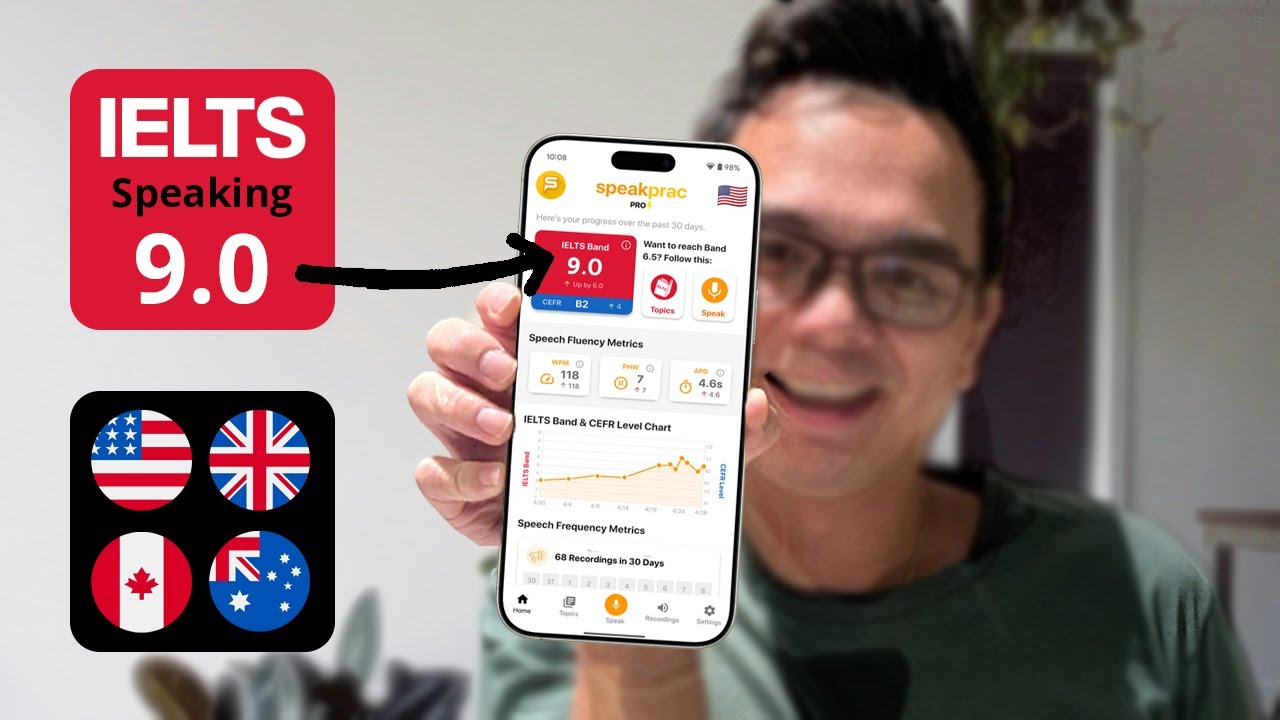
Your mission: record yourself answering practice questions (the SpeakPrac app makes this easy), then listen back carefully. Ask yourself:
- Is it subject-verb agreement?
- Is it using articles correctly?
- Is it the past simple tense?
Find your top two or three repeat offenders and focus intensely on just those. Fixing a handful of common errors will have a massive impact on your score.
Your Grammar Toolkit: Practical Structures That Work
The Mirroring Technique
The most powerful grammar technique I can share is the Mirroring Technique. It’s simple: listen to the grammar in the examiner’s question and mirror it back in your answer. This ensures you’re using the correct tense from the very start.
Example 1 — Examiner uses present perfect continuous:
“How long have you been learning English?”
Mirror it:
“I’ve been learning English since I was in high school, so it’s been about 10 years now.”
Example 2 — Examiner uses future with will:
“How do you think technology will change our lives in the next 20 years?”
Mirror it:
“I believe that AI will become much more integrated into our daily routines, and I also think more people will work from home.”
This isn’t cheating. It’s smart communication — and you already do it naturally in your own language.
Structures for Common Question Types
You don’t need fancy phrases. You need solid, simple structures that you can combine fluently:
For opinions:
- I think that…
- In my view…
- I strongly believe…
For cause and effect:
- …because…
- As a result…
- …which leads to…
For hypotheticals:
- If I had the chance, I would…
- If the government invested more, it would…
For comparing:
- …is much more interesting than…
- On the other hand…
The key is to combine these. For example:
I think that city life is much more exciting than country life because there are always new things to do and new people to meet.
In one clear, fluent sentence, you’ve just used three different structures — opinion, comparison, and cause. That is high-level grammar in action.
The SpeakPrac Cycle™: Your Active Grammar Feedback Loop
The fastest way to improve your grammar isn’t reading more textbooks. It’s creating an active feedback loop. I call this the SpeakPrac Cycle™:
Speak → Analyse → Improve → Speak Again
Here’s how to walk through a full cycle:
Step 1: Self-Diagnose with the Original Transcript
Record your answer to a practice question. In the SpeakPrac app, you get an instant transcript of exactly what you said. Listen back. You might hear things you didn’t notice while speaking — perhaps all your sentences are simple, or you’re repeating the same structure. This is your baseline.
Step 2: Get Inspiration from the Improved Transcript
Swipe to the Improved Transcript. This isn’t just about finding errors — it’s about getting inspiration. Compare a basic answer like:
On weekends, I like to relax. I watch movies. I meet my friends. Sometimes I go to a coffee shop.
…with the improved version:
On weekends, I’m all about relaxing. I usually catch up on some movies or meet up with friends. Yeah, hanging out at a café for a coffee and a chat is a real highlight — sometimes we just kick back and chill for a few hours.
The ideas are the same. But in the improved version, they’re linked — not just listed. That’s exactly what examiners mean by grammatical range.
Step 3: Close the Loop with Immediate Practice
Here’s where most students fail — they read the feedback, nod, and move on. Don’t do this. You need to close the feedback loop by immediately practising the new structure.
Let’s say the Quick Tips section highlights the connecting word although. Your task: hit the Speak button in the SpeakPrac app and freestyle — talk about your day, your city, anything — but use although once or twice:
Today was a pretty good day. I had a lot of work to do, although I managed to finish it all before 5 p.m. I’m thinking of getting pizza for dinner, although I should probably eat something healthier.
It doesn’t have to be a perfect speech. You’re just taking that new grammar rule for a test drive. Do this a few times, and the structure moves from a rule in your head to a tool you can use without thinking.
Systematic Grammar Building with Anki Flashcards
The SpeakPrac Cycle™ is powerful for improving based on your own speech. But if you want to systematically learn all the essential grammar rules from the ground up, I recommend using Anki — a free app that uses spaced repetition to help you memorise things efficiently.
I personally use Anki every day to learn languages. To save you time, we created the IELTS English Grammar Flashcards Bundle, broken into three decks based on your target band score:
- Bands 1–3 (Essential): Core sentence structures, tenses, and subject-verb agreement — the solid foundation.
- Bands 4–6 (Intermediate): Connecting words, conditionals, and clauses for building high-scoring complex sentences.
- Bands 7–9 (Advanced): Sophisticated structures, refined accuracy, and nuanced grammar for precise communication.
The best part? You can integrate these decks directly into your SpeakPrac Cycle™. When you learn a new rule from an Anki card, don’t just memorise it — open the SpeakPrac app, hit Speak, and use that rule in a real spoken sentence. That’s how you truly master it.
Your Action Plan
Here’s the truth: grammar improves when you use it in an active feedback loop — not when you study it passively from a textbook.
You now have everything you need:
- Bust the three myths — stop chasing perfect, complicated, or exhaustive grammar.
- Adopt the Communicator’s Mindset — let communication lead, and let grammar serve.
- Use the Mirroring Technique — let the examiner’s question guide your tense.
- Run the SpeakPrac Cycle™ — speak, analyse, and immediately practise the new structure.
- Build systematically with Anki — target your specific band level with the Grammar Flashcards Bundle.
With the right mindset and the right tools, anyone can speak English — including you.
Ready to take your speaking to the next level?
Apply today's tips in the SpeakPrac app and get instant AI feedback on all 4 IELTS criteria. Or master the fundamentals with my complete, free video course.