Want more strategies like this?
Join our free newsletter to get weekly Band 9 frameworks delivered straight to your inbox.
You’ve been standing in front of the mirror. You’ve been answering practice questions out loud. It feels productive. It feels safe. And when you walk away, you think: that was pretty good.
But here’s the problem — the mirror forgets everything the moment you walk away. Your words vanish as you speak them, and you’re left with nothing but a feeling. That feeling, as it turns out, is not reliable data.
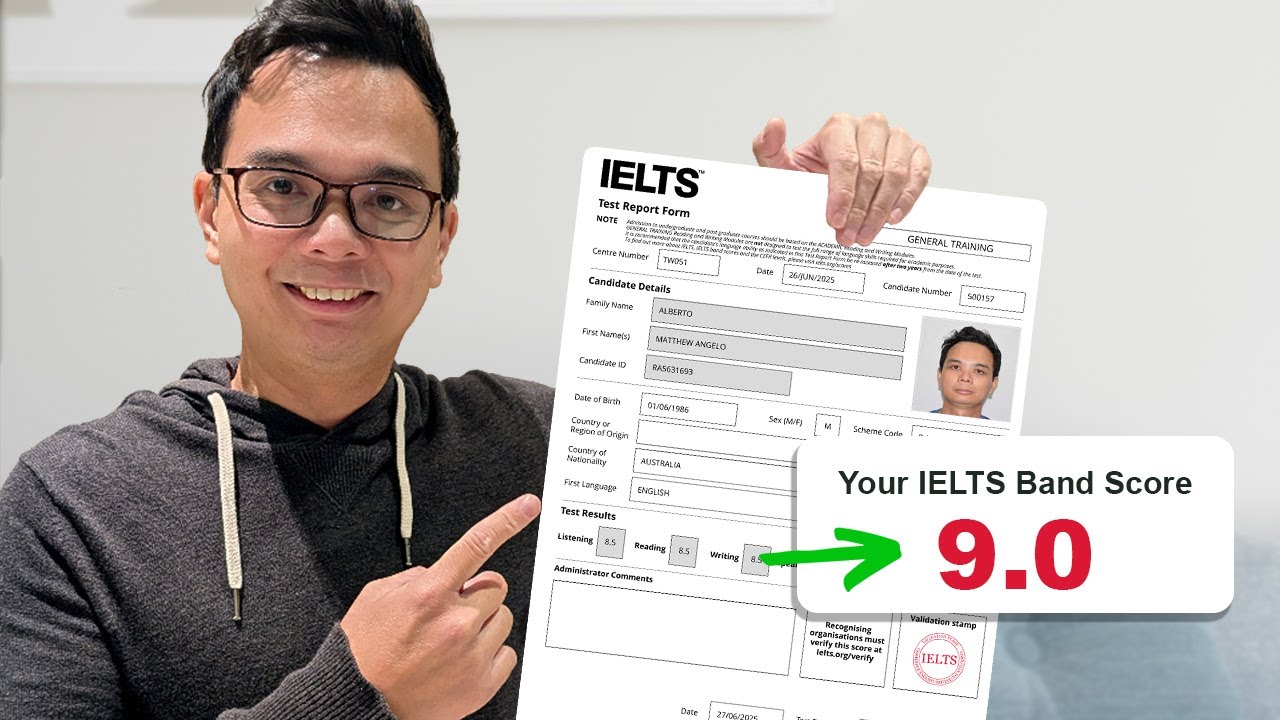
As someone who recently sat the official IELTS test and scored a perfect Band 9 in speaking — including Band 9 across all four criteria — I can tell you that mirror practice was never part of my preparation. Instead, I built something far more powerful: a recording archive. In this guide, I’ll show you exactly why this matters and how to use it to see real, measurable progress.
The Problem With Mirror Practice
When you practice speaking in front of a mirror, your brain is doing two things at once: producing English and trying to monitor it. The science here is simple — your brain can’t do both at the same time effectively. Language production takes priority, which means your self-monitoring is always lagging behind.
The result? You finish a practice session and walk away thinking you sounded fluent. But a trained IELTS examiner listening to that same performance might have caught things you completely missed:
- Unnatural pauses that interrupt your flow
- The same basic adjective repeated five times in 30 seconds
- Inconsistent verb tenses you didn’t even notice switching
Without a recording of what you actually said, you’re making decisions about your performance with no real data. You’re guessing. And when you’re preparing for a high-stakes exam, guessing is a strategy that will keep you stuck.
Why a Recording Archive Changes Everything
The core idea is straightforward: objective data is more reliable than how you feel on any given day.
When you practice for weeks or months without recordings, there will be days when you feel like you’re making zero progress — like you’re permanently stuck at a band 6 with no way out. Those feelings are not always accurate, but without evidence to contradict them, you’ll believe them.
A recording archive gives you that evidence. When you store every practice response, you can pull up a recording from 30 days ago and compare it to today’s response on the exact same topic. You’ll hear the difference yourself. Not because a teacher told you that you improved — because you can actually hear it.
What specific improvements will you notice over time?
- Pacing becomes smoother and more natural
- Vocabulary becomes sharper and more precise
- Coherence improves as your answers become more structured
- Filler sounds (um, ah) appear less frequently
That is genuine confidence — the kind that comes from evidence, not from reassurance.
A Real Question From a Real Student
I recently received a question from a SpeakPrac Pro user in Sri Lanka who asked whether there was a limit on recordings and whether storing too many would slow down the app. It’s a fair question, because most apps make you think about storage.
My answer: there is no limit. As a SpeakPrac Pro member, you can build hundreds or even thousands of recordings. They’re securely stored in the cloud, so they won’t slow down the app or take up significant space on your device. Your full recording history is accessible at any time.
That unlimited archive isn’t just a feature — it’s the entire strategy.
The SpeakPrac Cycle™: Building an Active Feedback Loop
Just storing recordings isn’t enough. You need to turn them into an active feedback loop. I call this the SpeakPrac Cycle™:
Speak → Analyze → Improve → Repeat
This is the framework I used during my own Band 9 preparation. Instead of relying on a mirror, I wanted real, objective data on my Fluency, Grammar, Vocabulary, and Pronunciation. So I built the SpeakPrac app to give myself exactly that — transcripts of what I said, words-per-minute data, and timestamps showing where I hesitated unnaturally.
That data is what helped me achieve a Band 9. Thousands of students are now using it for the same purpose.
How to Actually Analyze Your Recordings
Storing your recordings is step one. Knowing how to listen back to them is where the real work happens.
Listening to your own voice is uncomfortable at first — I know. But you need to push past that. The key is to focus on one criterion per recording session rather than trying to catch everything at once.
Here’s how I recommend structuring your review sessions:
Session 1: Grammar
Listen specifically for grammatical accuracy. Ask yourself:
- Did I use the correct verb tenses?
- Did I drop articles or mix up plurals?
- Did I construct complex sentences, or did I rely on short, simple ones?
Session 2: Vocabulary (Lexical Resource)
Focus entirely on word choice. Ask yourself:
- Did I repeat certain words — like important — multiple times?
- What stronger, more precise words could I have used instead?
- Did I use any collocations or topic-specific vocabulary naturally?
Session 3: Fluency
Count and record specific issues. Ask yourself:
- How many unnatural pauses did I make?
- How often did I use filler sounds like um or ah?
- Did my pacing feel smooth and natural, or rushed and choppy?
When you isolate one area at a time, mistakes become much easier to identify. Once you’ve spotted a specific issue, note the correction, then re-record the same answer — this time applying the fix deliberately. That is what intentional practice looks like. It’s also how you build the speaking confidence that carries you through exam day.
Your Long-Term Strategy: Never Delete a Recording
As the weeks pass and your archive grows, resist the urge to delete your older recordings. Those early files are some of the most valuable content in your collection — they are a detailed record of exactly where you started and which habits you’ve worked to change.
If you’re using the SpeakPrac app, your progress chart only works if you keep your recordings. The chart is a visual map of your growth over time, and every deleted recording is a data point you lose forever.
Here’s what I recommend for motivation in the final week before your test:
- Go back to your oldest recordings. Listen to how far you’ve come.
- Listen to your weakest recordings. They’ll remind you of the habits you still need to manage on test day.
This isn’t about feeling good — it’s about walking into the exam room prepared, informed, and in control.
The Bottom Line
The mirror forgets everything the moment you walk away. The archive remembers every word.
If you’re serious about your IELTS Speaking score, make the switch today. Use a voice recording app — even the built-in Voice Memo app on your phone is a start — and commit to the SpeakPrac Cycle™: speak, analyze, improve, repeat.
Real data beats good feelings every single time.
Ready to take your speaking to the next level?
Apply today's tips in the SpeakPrac app and get instant AI feedback on all 4 IELTS criteria. Or master the fundamentals with my complete, free video course.