Want more strategies like this?
Join our free newsletter to get weekly Band 9 frameworks delivered straight to your inbox.
Most students walk into the IELTS Speaking test room and immediately transform into a robot. They use words they’d never say in real life. They attempt complex grammar structures that get them twisted in knots. They’re so focused on impressing the examiner that they forget to simply communicate.
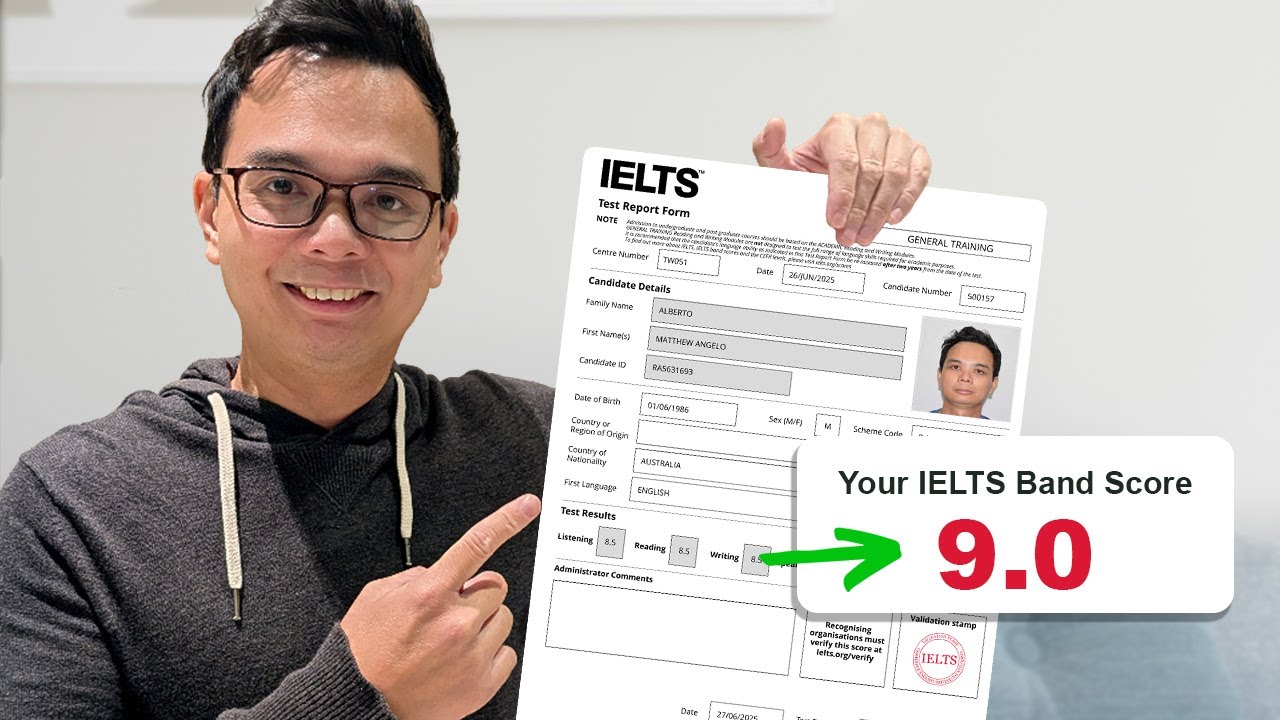
Here’s what I learned after scoring a perfect Band 9 — across all four marking criteria — in the official IELTS Speaking test: the examiner is not looking for a performance. They’re looking for a person. These seven tips will help you show up as exactly that.
Tip 1: Switch Off Your Exam Brain
The single most important mindset shift you can make is this: stop treating the test like a test.
When you enter that room thinking “I must impress this examiner,” everything tightens up — your vocabulary becomes forced, your grammar becomes clunky, and your answers start to sound scripted. Instead, I want you to think of the examiner as a colleague you’ve just met for coffee.
Be polite. Be professional. Above all, speak naturally.
Don’t focus on being impressive. Focus on being effective. That subtle shift removes an enormous amount of pressure and instantly makes your spoken English sound more fluent and authentic.
Tip 2: Stay in the Goldilocks Zone for Part 1
Part 1 of the IELTS Speaking test is a series of short, direct questions about familiar topics — your work, hobbies, hometown. The biggest mistake students make here is going to one of two extremes.
- Too short: One-word answers like “Student.” give the examiner nothing to grade.
- Too long: A five-minute monologue about your academic history is unnecessary and eats into the examiner’s time.
The sweet spot — the Goldilocks Zone — is two to three sentences, or roughly 20 seconds.
Use the A.R.E. Framework™
To hit that zone consistently, I developed and used the A.R.E. Framework™ before my test:
- Answer the question directly.
- Reason — explain why.
- Example or Explanation — give a brief one.
Three clear sentences. Every single time. It’s the exact standard you should be aiming for on every Part 1 question.
Tip 3: Use the Topic Diamond™ for Part 2
Part 2 is the long turn. You receive a cue card and are expected to speak for around two minutes. This is where most students fall apart.
They look at the bullet points on the cue card and treat them like a mandatory checklist — rushing through each one in rapid succession. The result? They finish in 45 seconds, start repeating themselves, and panic sets in.
Here’s the secret: the bullet points are just a guide. They are optional.
What matters is the main topic written at the top of the cue card. Your job is to expand on that topic naturally.
The Topic Diamond™
To do this, I created the Topic Diamond™ — a framework that structures your answer across four dimensions:
- The Past — the history or background of the topic
- The Present — what it looks like now
- The Future — your hopes, plans, or predictions
- Your Opinion — how it has personally affected you
Instead of listing random facts, you’re telling a story. This is exactly what separates a Band 6 answer from a Band 9 one. Next time you feel like you’ve run out of things to say, simply move to the next point on the diamond.
Tip 4: Use Precise Words, Not Impressive Ones
There is a widespread myth in IELTS preparation: you need to stuff your answers with big, academic vocabulary to score Band 9.
Students memorise words like plethora or ubiquitous and then force them into their answers. This can actively lower your score — especially if you hesitate while searching for the word, or if it sounds unnatural in context.
A Band 9 speaker doesn’t use confusing words. They use precise ones.
The real marker of high Lexical Resource is collocations — words that naturally go together in English. For example:
- ✅ heavy rain (not big rain or strong rain)
- ✅ make a decision (not do a decision)
- ✅ deeply concerned (not very concerned — though this is acceptable too)
When it comes to vocabulary, always prioritise natural phrasing and accuracy over complexity.
Tip 5: Practice Out Loud and Track Your Data
You cannot improve your speaking by reading about speaking. You need to open your mouth and actually practice.
But here’s the problem with just “practicing more”: without objective feedback, you don’t know what you’re actually fixing. When I was preparing for my test, I knew that Fluency was one of my biggest weaknesses. I tend to overthink when I speak, which causes unnecessary pauses.
To solve this, I needed data — my speech rate, my pause frequency, my use of filler words. This is exactly why I built the SpeakPrac app. I used it to:
- Practice on random IELTS Speaking questions
- Get a breakdown of my spoken fluency
- Identify specific weaknesses in the four marking criteria
Whatever resource you use, I strongly recommend tools that give you feedback, not just more questions to practice. Anyone can speak English. The key is pinpointing your specific weaknesses so you can fix them systematically.
Tip 6: Embrace Strategic Silence
Many students are terrified of silence. The moment they can’t think of a word, they fill the gap with a stream of ums and ahs — which directly damages their Fluency score.
Here’s what you need to remember: native English speakers pause too. The difference is that they pause purposefully.
If you need a moment to think, don’t leave a dead silence. Instead, use a natural filler phrase to keep your English flowing:
- “That’s an interesting question, you know, I think…”
- “I’ve never thought about it that way before — I suppose…”
- “That’s a difficult one, but I’d say…”
These phrases buy you two to three seconds, signal to the examiner that you’re a thoughtful communicator, and — crucially — keep your spoken English moving forward.
Tip 7: Don’t Aim for Perfection
This is the one that trips up so many high-achieving students: you do not need a perfect performance to score Band 9.
If you look at the official Band 9 descriptors, they explicitly account for occasional slips in grammar and vocabulary. A small error here and there will not cost you the score — provided you keep communicating confidently.
What examiners are looking for is your ability to recover from those mistakes. If you stumble, correct yourself briefly and move on. Do not freeze. Do not apologise. Do not spiral.
Your confidence is worth just as much as your grammar in that room. Keep talking.
The Bottom Line
Getting a high band score in IELTS Speaking isn’t about being perfect. It’s about being clear, natural, and structured — three things anyone can train for.
To recap the seven tips:
- Mindset — Speak naturally, not robotically.
- Part 1 — Stay in the Goldilocks Zone with the A.R.E. Framework™.
- Part 2 — Use the Topic Diamond™ to expand your answers across time.
- Vocabulary — Use precise, natural collocations — not forced academic words.
- Practice — Speak out loud and use feedback tools to track real progress.
- Silence — Use filler phrases to pause purposefully.
- Perfection — Let go of it. Recover, adapt, and keep going.
Apply these consistently in your preparation, and you’ll walk into that test room with a completely different level of confidence.
Ready to take your speaking to the next level?
Apply today's tips in the SpeakPrac app and get instant AI feedback on all 4 IELTS criteria. Or master the fundamentals with my complete, free video course.