Want more strategies like this?
Join our free newsletter to get weekly Band 9 frameworks delivered straight to your inbox.
Most students walk into the IELTS Speaking test believing that being smart, having an interesting life, or knowing complex vocabulary is what earns a high score. They spend weeks memorising impressive-sounding phrases and rehearsing elaborate stories—and then stall at Band 6.
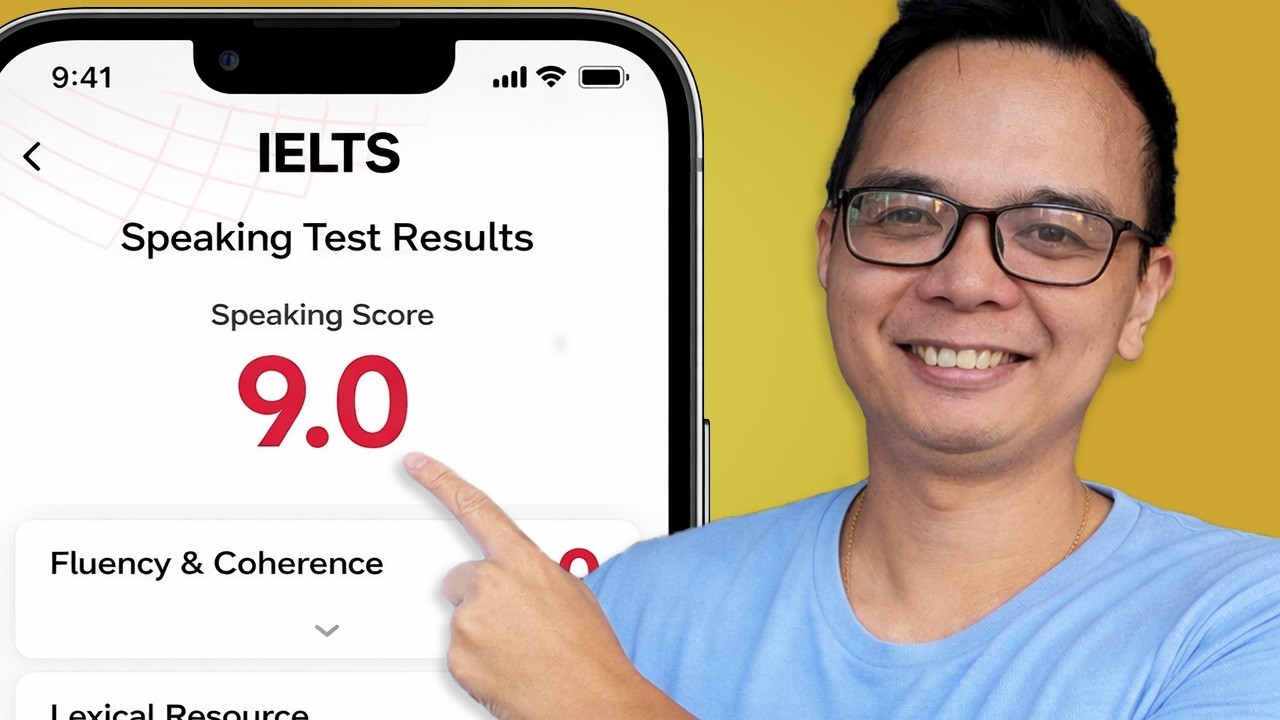
Here is the truth: the IELTS Speaking test is entirely about how well you communicate in English. When I sat the official IELTS test and scored a perfect Band 9 across all four criteria, it was not because I had a fascinating life story. It was because I understood precisely what the examiners were measuring—and I had a clear system for delivering it.
This guide gives you that complete system: the test structure, the four scoring criteria, and the three proven frameworks for every part of the test.
Understanding the Test Structure
The IELTS Speaking test runs for 11 to 14 minutes and is divided into three parts:
- Part 1 (4–5 minutes): A warm-up conversation with personal questions about your life, habits, and preferences.
- Part 2 (2 minutes): A monologue based on a cue card topic, with one minute of preparation time.
- Part 3 (4–5 minutes): A deeper discussion of abstract ideas connected to the Part 2 topic.
Each part has a distinct purpose and requires a different approach. Treating all three the same is one of the most common mistakes students make.
The Four Scoring Criteria (What Examiners Actually Measure)
Your score is determined by four equally weighted criteria. Understanding these is essential before you can improve.
1. Fluency and Coherence
How smoothly you speak and how logically you connect your ideas. This is not about talking fast—it is about keeping natural speech flow and organising your thoughts clearly.
2. Pronunciation
Clarity of your speech, not perfection of accent. An examiner will never mark you down for having a non-British or non-American accent. What matters is whether your message is easy to understand.
3. Lexical Resource
Using the right words accurately. Note: this is not about stuffing your answers with sophisticated vocabulary you barely understand. A precise, well-used word at the right moment scores far higher than a complex word used incorrectly.
4. Grammatical Range and Accuracy
How varied your sentence structures are and how effectively you use them. Minor errors are acceptable. What the examiner wants to see is that you can use a range of structures—not just simple subject-verb-object sentences.
Part 1: The A.R.E. Framework™
Part 1 is all about who you are. The questions are personal and conversational, but many students either answer too briefly (“Yes, I like it.”) or ramble without structure.
The fix is the A.R.E. Framework™:
- A — Answer the question directly.
- R — Give your Reason.
- E — Provide an Example or Explanation.
Example question: Do you like cooking?
Weak answer: “Yes, I like cooking.”
A.R.E. Framework™ answer: “Yes, I really enjoy cooking because it helps me relax after work. For example, last weekend I made Thai curry for the first time, and my family absolutely loved it.”
That response is complete, natural, and demonstrates all four marking criteria in under 30 seconds. Aim for two to three sentences per Part 1 answer, which takes roughly 20 seconds. This gives the examiner enough to assess you without overstaying your welcome on a single question.
Part 2: The Topic Diamond™
Part 2 is where many students freeze. You are handed a cue card, given one minute to prepare, and then expected to speak for two full minutes. Running out of content mid-answer is a fluency killer.
The Topic Diamond™ solves this by giving you a universal four-point structure that works for any topic:
- Past — What is the history or background? How did you first encounter this?
- Present — What is it like now? What are its key features?
- Future — What are your plans or hopes related to this topic?
- Opinions / Feelings — How has it impacted you? How does it make you feel?
Rather than listing facts, you are taking the examiner on a journey through time and emotion. This creates a logical, coherent narrative that naturally fills two minutes—and demonstrates Coherence, Lexical Resource, and Grammar simultaneously.
The beauty of the Topic Diamond™ is that the bullet points on the cue card are optional. You do not have to follow them. If the structure on the card does not suit you, use the diamond instead.
Part 3: The I.D.E.A. Framework™
Part 3 pushes you into abstract, opinion-based territory. Questions like “Should governments invest more in arts education?” or “Do you think technology is making people more isolated?” require you to do more than give a personal answer—you need to demonstrate depth of thought.
The I.D.E.A. Framework™ gives you that structure:
- I — State your Idea clearly.
- D — Develop it. Give your reason why.
- E — Provide an Example.
- A — Share an Alternative viewpoint.
Example question: Should children learn a second language from an early age?
I.D.E.A. Framework™ answer: “I strongly believe children should learn languages early because their brains can absorb new languages naturally and quickly. For example, my friend’s five-year-old daughter switches effortlessly between Mandarin and English at her bilingual kindergarten. Now, some parents might argue that learning two languages simultaneously confuses young children—but research consistently shows this is not the case.”
That response is complete, balanced, and high-scoring. It demonstrates an opinion, logical development, a concrete example, and critical thinking—exactly what examiners are looking for in Part 3.
The Biggest Mistakes to Avoid
These are the habits that keep students at Band 5 or 6, no matter how much they practice:
- Memorising full answers. Examiners are trained to spot rehearsed responses immediately. It damages your score for Fluency and Lexical Resource.
- Forcing complex vocabulary you do not fully understand. An incorrectly used advanced word is worse than a simple word used precisely.
- Speaking in a flat, monotone voice. Intonation is a core part of your Pronunciation score. Let your voice rise and fall naturally.
- Pausing endlessly to find the perfect sentence. Natural speech includes minor errors. Chasing perfection creates unnatural, broken delivery.
Your Action Plan
- Practice speaking out loud every single day. Record yourself and listen back critically.
- Use the frameworks: A.R.E. Framework™ for Part 1, Topic Diamond™ for Part 2, and I.D.E.A. Framework™ for Part 3.
- Prioritise natural communication over perfection. Fluency and Coherence reward smooth, connected speech—not flawless grammar.
- Build confidence with focused, deliberate practice. When I was preparing for my own IELTS test, I used the SpeakPrac app daily to practise speeches and get instant AI feedback on pronunciation, vocabulary, grammar, and fluency.
The difference between a Band 6 and a Band 9 is not talent. It is understanding exactly what the test measures—and then training strategically to deliver it every time.
Ready to take your speaking to the next level?
Apply today's tips in the SpeakPrac app and get instant AI feedback on all 4 IELTS criteria. Or master the fundamentals with my complete, free video course.