Want more strategies like this?
Join our free newsletter to get weekly Band 9 frameworks delivered straight to your inbox.
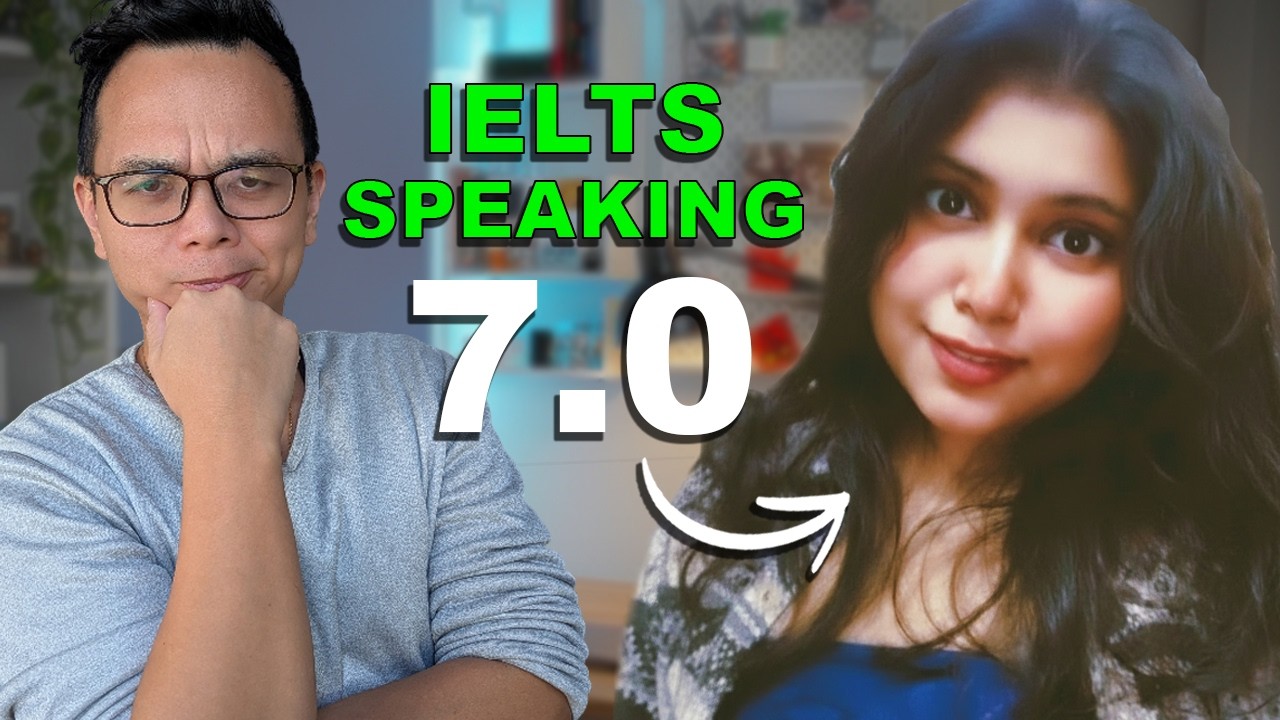
Imagine four and a half seconds of complete silence right at the start of your IELTS Speaking test. That is exactly what happened when I analyzed a real recording from one of my students. Before a single word was spoken, the examiner had already formed an impression — and it was not a good one.
That silence, and what came after it, is one of the clearest examples I have ever seen of how a vocabulary gap quietly destroys an entire IELTS Speaking performance. If you are stuck at Band 5 and cannot seem to break through to Band 7, your biggest enemy is probably not your grammar or your accent. It is your vocabulary — specifically, your over-reliance on vague, repeated words.
In this guide, I am going to break down exactly what is happening in a real Band 5 response, show you why it stalls at that score, and give you the precise fix to move the needle toward Band 7.
The Real Band 5 Response: A Breakdown
The question was a standard Part 1 topic: Do you like to shop alone or with friends?
Here is what the student — I’ll call her Enkhjin — said:
“I really like to shop with my friends because it’s really fun and it’s really helpful for my society and things and it’s really fun.”
Before I even get to the scoring, notice what happened: she repeated “really fun” three times in a single response. That repetition is not just an aesthetic issue — it is a direct signal to the examiner that she has run out of language options.
Let me now score this response across all four official IELTS Speaking criteria.
Grammatical Range and Accuracy
Her grammar is functional but basic. The dominant structure throughout is a long chain of and…and…and, stringing ideas together without any subordinate clauses or flexible sentence structures. This is a textbook Band 5 pattern. To reach Band 7, she needs to use structures like although, which, because of, and despite to build more complex, layered sentences.
Pronunciation
Her clarity is generally acceptable — I could follow what she was saying. However, there were moments where word endings were not crisp. For example, the th sound in with came out closer to wit or wid. More importantly, her pronunciation score suffered indirectly because of her hesitation. When you are struggling to find words, your intonation and stress patterns collapse. It is very hard to demonstrate strong pronunciation features when you are simultaneously searching for vocabulary.
Fluency and Coherence
This is where the score takes the biggest hit. That four-and-a-half-second silence at the start is a major Fluency penalty. It tells the examiner that she is translating inside her head rather than thinking in English. The repeated phrase really fun compounds this — it is audible evidence of limited language range, which directly lowers her Coherence score.
Lexical Resource (Vocabulary)
This is Enkhjin’s core problem, and it is the root cause of nearly every other issue in her response. Let me show you why.
Why Vocabulary Is the Root Cause
Look carefully at this phrase from her response: “helpful for my society and things.”
She almost certainly meant social life or friendships. But she could not find those words in the moment, so she settled for society — which carries a completely different meaning in English — and then added things as a vague filler. This is what linguists call lexical avoidance: reaching for the closest word you know instead of the precise word you need.
This matters enormously because Band 7 requires you to use less common vocabulary with some degree of precision. When the examiner hears society used incorrectly and then things used as a filler, they classify this as Band 5 Lexical Resource — limited flexibility, imprecise word choice.
Here is the crucial insight: fixing her vocabulary will also fix her fluency. She paused because she did not have the words. If she had those words readily available, the silence disappears. The fluency problem and the vocabulary problem are the same problem.
The Fix: Learn Collocations, Not Just Single Words
The most common mistake IELTS students make when building vocabulary is studying individual words in isolation. They learn fun. They learn good. They learn happy. But the examiner is not listening for single impressive words. They are listening for natural, precise collocations — the way words naturally combine in fluent English.
Here is a direct comparison showing what this looks like in practice:
| Enkhjin’s Phrasing | Collocation Upgrade |
|---|---|
| society | social circle |
| really fun | a great way to bond |
| helpful | invaluable / well worth it |
| things | (remove entirely — add a specific example instead) |
Notice that social circle is not a harder word — it is just a more precise pairing of two simple words. A great way to bond is equally accessible, but it sounds far more natural and demonstrates Lexical Resource in a way that a single word never could.
Synonyms for “Really Fun” (Stop Repeating It)
If really fun is your default phrase, here are direct replacements you can start using immediately:
- enjoyable — It’s really enjoyable to get a second opinion.
- entertaining — The whole experience is genuinely entertaining.
- engaging — I find it a much more engaging way to spend an afternoon.
- a great way to bond — Shopping with friends is a great way to bond.
- genuinely rewarding — I find it genuinely rewarding when we help each other choose outfits.
Each of these demonstrates range. Using even two of them in a single response signals to the examiner that you have flexible vocabulary at your disposal.
What a Band 7+ Response Actually Sounds Like
Here is how I would answer the same question — Do you like to shop alone or with friends? — to demonstrate the kind of vocabulary that moves the needle:
“I definitely prefer shopping with friends. I treat it more like a social outing than just running errands. It’s great to have a second opinion on clothes, which honestly saves me from making terrible fashion choices.”
Break down what is happening here:
- “social outing” — a precise collocation that replaces the vague word society
- “running errands” — a natural phrase that creates a contrast and shows range
- “second opinion” — a collocation that replaces the word helpful with something far more specific
- The sentence structure uses which as a relative clause, moving beyond the and…and…and pattern
This response does not use a single word that is especially advanced. The power comes entirely from precision and natural collocation, not from memorizing obscure vocabulary.
Your Action Plan: The Collocation-First Method
If you are currently at Band 5 and targeting Band 7, here is how to approach vocabulary practice:
Identify your go-to filler words. Record yourself answering a Part 1 question and listen back. Note every time you say really, things, good, fun, or helpful. These are your targets.
Replace each target with a collocation, not just a synonym. Do not swap fun for enjoyable alone — learn genuinely enjoyable, a great way to bond, a surprisingly rewarding experience. The pairing matters.
Practice topic-specific collocations. Common Part 1 topics like shopping, travel, food, and hobbies each have their own natural vocabulary clusters. For shopping: browsing options, getting a second opinion, a social outing, running errands, impulse purchase. Learn these as units.
Use the SpeakPrac app to pressure-test your vocabulary. Record your answers to random Part 1, 2, and 3 questions, get instant AI feedback and an estimated band score, and listen for the moments where you reach for a vague filler. That moment of reaching is your next vocabulary target.
The Bottom Line
Enkhjin’s struggle with vague language is not unique to her — it is one of the most common patterns I see at Band 5. The good news is that it is also one of the most fixable. You do not need a larger vocabulary. You need a more precise one.
Stop learning words. Start learning collocations. The moment you replace helpful for my society and things with a social outing and a great way to bond, the examiner stops hearing Band 5 and starts hearing Band 7.
That shift does not require months of study. It requires a deliberate change in how you practice.
Ready to take your speaking to the next level?
Apply today's tips in the SpeakPrac app and get instant AI feedback on all 4 IELTS criteria. Or master the fundamentals with my complete, free video course.