Want more strategies like this?
Join our free newsletter to get weekly Band 9 frameworks delivered straight to your inbox.
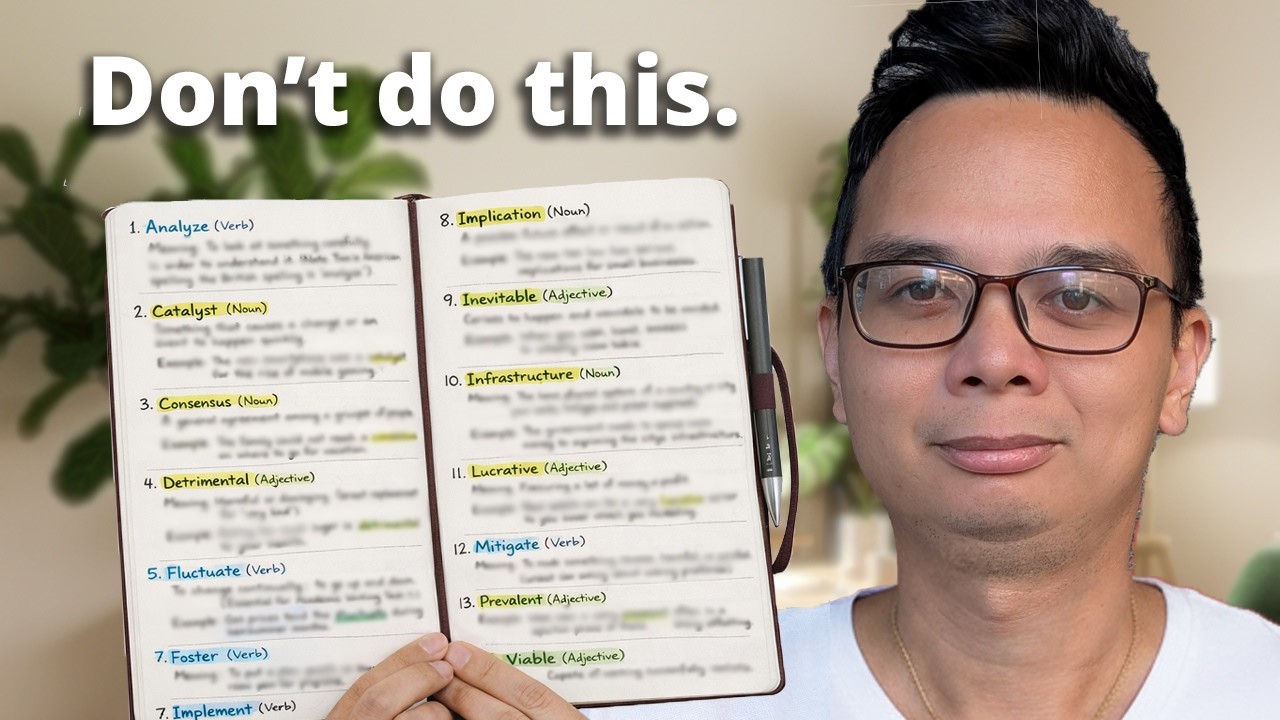
You have been studying vocabulary for weeks. You have a notebook full of impressive-looking words, maybe even some you copied from a “Band 9 word list” you found online. But when you sit down to practice — or worse, when you walk into the exam room — your mind goes blank. The words just aren’t there when you need them.
This is not a memory problem. It is a method problem. I know this because I went through the exact same frustration before I sat my official IELTS test and scored a perfect Band 9 for IELTS Speaking — including a Band 9 for Lexical Resource. In this guide, I am going to show you exactly why the way most students study vocabulary is broken, and give you the precise framework I used to fix it.
The Word Collector Trap
The first thing we need to address is a habit I call the word collector mindset.
Most students treat IELTS vocabulary like collecting souvenirs. They find lists of “Band 9 words” online, discover impressively long words, write them down in a notebook, and then hope they can force those words into their responses on test day.
This is a trap.
The IELTS examiner is not checking whether you have memorised a vocabulary list. What they want to see is whether you can combine words naturally to communicate meaning. If you use complex words incorrectly, it actually sounds worse than using simpler words correctly.
The fix is to stop being a word collector and start becoming a word mapper. That is where the Vocab M.A.P. Method™ comes in.
The Vocab M.A.P. Method™
This is the core strategy I used in my own preparation. Whenever I came across any new English word, I applied three steps: Master, Associate, Practice.
M — Master
When you encounter a new word, you need to truly master its core identity — not just look up the translation in your native language.
You need to know two things:
- Its form — Is it a noun, a verb, or an adjective? How does it change in different sentences?
- Its pronunciation — This one is critical and most students completely skip it.
If you know the meaning of a word but cannot pronounce it clearly, that word becomes useless to you in the IELTS Speaking test. Mastering pronunciation is not optional. It is the foundation.
A — Associate
In English, words do not live in isolation. They have partners called collocations — the other words they naturally and predictably travel with.
Take the word decision. In English, you do not do a decision. You make a decision.
Take the word rain. In English, we do not have strong rain or big rain. We have heavy rain.
If you say strong rain or do a decision in the exam, the examiner will understand you — but they will immediately know you are not operating at a Band 7, 8, or 9 level. Collocations are a direct signal to the examiner of your true language proficiency.
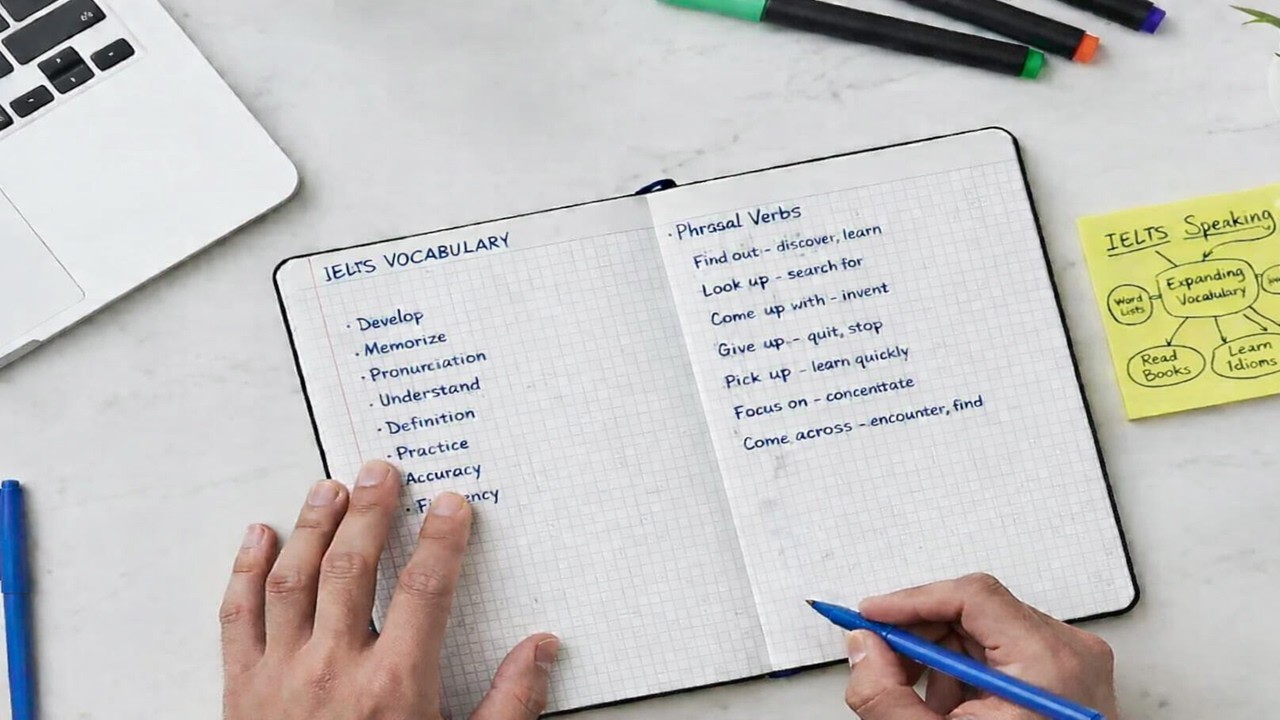
When you come across a new word, do not just write the word itself. Write the phrases it lives in. Map out its natural companions.
P — Practice
This is the step that almost every student skips, and it is the most important one.
You cannot learn to swim by reading a book about swimming. In the same way, you cannot own a vocabulary word by reading it on a list. You need to speak the word out loud in a full sentence and move it from your passive memory into your active memory.
Whether you use an app, speak in front of a mirror, or record yourself — you must speak. The moment you say a word out loud in a sentence that you constructed, it starts to become yours.
When I was preparing for my own exam, I wanted a space where I could try out different IELTS questions and get feedback on the vocabulary I was using. I wanted to see if there were alternative, higher-level ways to express my ideas. That is why I built the SpeakPrac app. It includes an improved transcript feature that shows you how a high-level scorer might phrase your same ideas, along with a quick tips section for instant feedback on your main vocabulary issues.
What Examiners Actually Listen For
When marking your Lexical Resource, there are two specific things examiners look for that most students miss entirely.
1. Idiomatic Language
Be careful — this does not mean you should use colourful idioms in every sentence. The examiner does not want to hear it’s raining cats and dogs every time you talk about the weather. Native speakers simply do not talk like that.
Idiomatic language means using natural, authentic phrasing. It means using phrasal verbs like look into and catch up with. It means using conversational markers like to be honest or I guess you could say. This natural fluency is what separates a Band 6 response from a Band 7, 8, or 9.
2. Paraphrasing
Paraphrasing is your safety net, and it is one of the most powerful tools you have in the exam room.
Sometimes your mind will go blank. You cannot find the exact word you need in the moment. A Band 6 student will panic and go silent. A Band 9 student behaves like a chameleon — they adapt and describe what they mean instead.
If you forget the word accountant, you do not freeze. You say: “someone who manages the finances of a company.”
This tells the examiner that you have flexible control over the English language. It signals confidence. And crucially, it keeps you talking, which protects your Fluency score at the same time.
Your Action Plan
Here is your summary for putting the Vocab M.A.P. Method™ into action today:
- Stop collecting lists of big words.
- Master every new word — know its form and nail its pronunciation.
- Associate the collocations — write the phrases, not just the word.
- Practice by speaking words out loud in full sentences.
- Focus on natural, idiomatic combinations rather than academic complexity.
- Paraphrase confidently if you ever get stuck on a specific word.
The difference between a student who plateaus at Band 6 and one who breaks through to Band 7, 8, or 9 is almost never the size of their vocabulary list. It is the depth of their relationship with the words they already know.
Ready to take your speaking to the next level?
Apply today's tips in the SpeakPrac app and get instant AI feedback on all 4 IELTS criteria. Or master the fundamentals with my complete, free video course.